Perspective

A few weeks ago my wife and I were delayed while driving home over the Oregon Cascades on Highway 22.  There was an accident a few miles ahead of us that shut down traffic in both directions for 3 hours.   We certainly hadn’t anticipated that.

I can remember a time in my past when a delay like this, or even one much shorter, would have caused me great frustration and irritation.  Fortunately, I don’t get irritated over things like this anymore.  What has helped me most in this area is making sure I take a moment and actually put things in the proper perspective.

Yes, we were delayed for 3 hours, but we were also very fortunate that we weren’t involved in the accident ahead of us.  I’m sure the people who were involved would much rather have only been delayed versus having their car damaged, being injured, or experiencing loss of life.  With that perspective in mind, it made it really hard for me to get upset and start complaining, especially when I’m sitting in the beautiful Oregon Cascades with my wife, knowing we’ll be on our way soon.  In light of that, I really had nothing to complain about.

I think that when we lack the proper perspective, we often let little things frustrate us unnecessarily.

The next time you find yourself getting frustrated, pause for a moment and make sure you have the proper perspective on the situation.  If you don’t, then change your perspective.  It’s a great way to not only alleviate unnecessary stress and frustration.  It’s also a great reminder of what we have to be grateful for.
Without Even Knowing

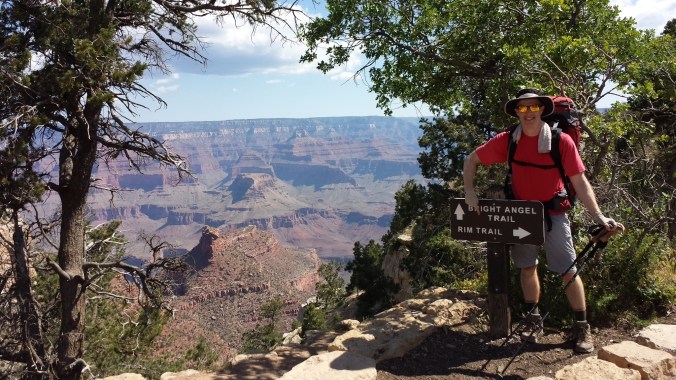
On Friday June 2nd at about 9:45am Pacific Time, I completed the Rim to Rim hike in the Grand Canyon.  This is a hike I have wanted to do since first visiting the Grand Canyon back in 2013.  It was a fantastic experience that I will never forget.

Completion

One of the key motivators for doing this hike was a view of Plateau Point I saw from the South Rim during my visit in 2013.  Plateau Point is easily visible from the south rim of the canyon, just west of the El Tovar Lodge.

Plateau Point

What captivated me about this view was the small trail that lead out to the point.  From my vantage several thousand feet above I could see people walking along that trail toward the end of the point.  As I watched them, I wondered what type of view they must have and how great it must be to be down there walking that trail.  Their presence on the trail intrigued me and stirred a desire to find out for myself what that experience is like.

The people I saw on the tail had no idea that I was watching them and that their presence on the trail was motivating me to one day hike that trail as part of my Rim to Rim experience.  As I hiked the trail to the end of Plateau Point last week, I wondered if there were people on the South Rim watching me.  I’d like to think there was someone that saw me and thought, “That looks like something I’d like to do.  I’m going to make that happen!”

I think we can motivate others to do great things without even knowing it.  The people I saw on Plateau Point back in 2013 had no idea they were inspiring me to take action.  They were simply doing their thing out on the trail.

I like to think that maybe I’ve been able to do the same for others.

Choosing Responses

Last Saturday I got a phone call from a relative who was experiencing computer problems and they needed help.  Computers are not this person’s thing, so when something with their computer goes wrong, it’s a catastrophe for them.  This case was no exception.  They were frustrated, stressed out, worked up, and not handling it very well.

As I was helping them solve their computer issue, it would have been easy to let this person’s stress and negative energy cause me to become stressed out and irritable as well.  (In the past, that’s exactly what I would have done!)  But a negative response to a stressful situation is not a forgone conclusion, it’s a choice.

I think that’s good news!  If our negative response to a stressful situation is a choice, that means we can choose to respond positively instead.

Other people don’t make us behave poorly or bring out the worst in us.  The more accurate statement is that we chose to behave poorly around them.

While that comment stings a little, it also reminds me that other people don’t have control over how I respond to them, unless I hand control over to them.  Ultimately, we are each responsible for our responses, regardless of the influence of others.  And for that, I’m thankful.

The next time you feel yourself getting stressed out or worked up because of someone else’s negative influence, pause for a moment and remember that how you respond is your choice.  Then, choose how you ‘d like to respond.

More Similar Than Not

My wife and I spend a long weekend in New York City a couple of weeks ago.  It was our second time in the city and we got to see several sights we didn’t get to on our first visit, like Ellis Island, the 9/11 museum, and walking across the Brooklyn Bridge on a beautiful sunny day.  We had a great time!

One of my favorite things about being in New York City is hearing all the different languages being spoken and interacting with people from all over the world.  It again reminds me that regardless of where we’re from or our cultural background, we’re all more similar than we realize.

For example, we were outside Federal Hall Saturday morning the same time as a large group from China.  I was intrigued by this group as I noticed how they all wanted their picture taking under the large statue of George Washington.  I especially enjoyed watching all of the different poses they were making.  There was everything from the classic family vacation photo, to the “thumbs up” sign, as well as both arms stretched skyward, all the while, with faces displaying big genuine grins.

Federal Hall

We witnessed this type of scene being played out throughout the city with people from all over the globe.  Regardless of their culture or homeland, they looked like tourists having a good time.  In that respect, we all looked the same.

It was refreshing to see, in light of current global political climate.  There seems to be a lot of focus, and likely fear, on how we’re different from one another.  It was nice to see just how similar we are all as fellow human beings.

Anticipation

I can’t wait for bright, clear, sunny days to become the norm!  After a long gray fall and winter in the Pacific Northwest, most everyone here is eager for the sun to make an extended appearance.

The clear days of late spring and summer in Oregon are extremely beautiful.  I think it’s the anticipation of their arrival that keep people going through the gray and rain.  At least it is for me.

I find life more interesting and exciting when I have something in the future to look forward to.  Whether it’s an upcoming trip or event, a scheduled connection with others or the changing of the seasons and the activities each one brings, the anticipation of these events enhances my enjoyment of them.

Anticipation is also a great positive motivator.  For example, if you’re earning a degree or learning to play a musical instrument, there will be times when your progress feels small or slow.  This is where you can get frustrated and consider giving up.  However, if you can anticipate the excitement of receiving your diploma or being able to skillfully play that musical instrument, you’ll be much more likely to successfully navigate through your frustration and move on toward completing what you’ve set out to do.

So what are you positively anticipating in your not-too-distant future?  What outcome can you see in your mind that you haven’t attainted yet?  If the answer is “nothing”, begin thinking of something you’d like to do or achieve and take steps to make it happen, all the while keeping the anticipation of its arrival or completion in your mind.

Positive anticipation is a pulling force.  It pulls us in the direction we want to go and keeps us on track, even when the path ahead feels gray and rainy.  Our anticipation reminds us that sunnier days are just ahead.

Calm in the Midst of Chaos

When I sat down to write this week’s blog, I looked out the office window and I noticed, across the busy 4 lane highway, a Canadian goose lying down in the grass on the other side of the road.  I didn’t see any evidence of a nest or eggs, as this goose had gotten up to move to a new position a couple of times, so it was a rather strange site.

As the busy traffic, only a couple of short feet away, whisked by, this goose seemed totally calm, content, and even relaxed.  He (or she) is the picture of calm in the midst of a chaotic environment.

Goose

The more I watched this silly goose, the more impressed I was with his calm demeanor in his chosen environment.  Ultimately, I thought about how I’d like to show the same unshakable calm whenever I find myself in a chaotic or stressful scenario.

I certainly don’t know what my feathered-friend’s secret is, but I do think there are some behaviors we can practice to help us stay calm and in control when things or people around us are not.

  • Don’t over-react when the stakes are low.  When we’re under pressure, I think we tend to react rather than respond.  Reacting is more automatic.  Responding involves deciding how we are going answer the situation before us.  When we respond we are intentional.  If we can train ourselves to respond calmly to small scale events, we will be training ourselves to do likewise when the stakes are higher.
  • Maintain the proper perspective. When you’re feeling stressed out or like things are getting chaotic, ask yourself if wigging out is really warranted.  With few small exceptions, it’s usually not.
  • Practice being calm. Make it a point to spend time every day engaging in calming activities.  This could include things like:
    • Reading
    • Praying or reading the Bible
    • Meditating
    • Yoga
    • Going for a walk
    • Listening to relaxing music
    • Having a good conversation with someone you care about

While the list is endless, the point is to make sure we’re doing something calming every day.

This goose’s appearance is very timely, as I’ve been focusing on integrating more calming activities into my own life recently.  I’m grateful I got to witness this example.

Choosing the Right Path

Back in school, I wasn’t the best test taker.  I usually didn’t prepare very well and my technique when I got stuck, which was often, amounted to little more than closing my eyes and selecting whichever answer my pencil landed on.  Fortunately, my studying and test taking habits have gotten much better.

Earlier this week I was taking an exam for work.  I had prepared well and was ready to take the test.  However, about half way into the exam I got stuck on a couple of questions and also noticed that I might be a little behind, based on time and questions remaining.  For a moment, I could sense the beginnings of feeling frazzled.  (I’m very familiar with what this feels like, as it was a regular occurrence in school.)

Suddenly all these non-productive thoughts started to flood my mind:

  • “You’re not going to get the score you need to pass.”
  • “You’re going to have to retake this test.”
  • “Think of all the time you’re going to have to spend re-studying!”
  • “You’re half-way through your allotted time and you still have half the questions left AND several you have to go back and review. You’ll never make it!”
  • “You don’t know this material as well as you thought. Perhaps you weren’t ready to take this exam.”

I felt like I had approached a very real fork in the road.  The path to the left is where I would decide that these thoughts had merit and as a result, I’d allow myself to get sloppy and lazy in how I approached the rest of the exam, knowing that failure was likely where I was heading.  The path to the right is where I would recognize my thoughts for what they were (a distraction and not a prophecy), push them to the side, and double down on doing my very best.

I chose the path to the right.  I also scored a 93%.  Well beyond what was needed to pass.

It’s amazing to me how my own negative thoughts felt like a physical force pushing against me, much like a headwind against a runner or cyclist.  The best way we can combat the negative force of our own thoughts is by replacing them with thoughts of determination and commitment to successfully complete what we’ve set out to do.  (If that feels challenging in the moment, starting with a prayer would be a good way to begin.)

When you face the headwind of your own negative thinking, realize that these thoughts are not prophetic, and you’re not required to agree with them.  Then, immediately challenge them with positive thoughts and actions that support those positive thoughts.

We can control our thoughts and ultimately use them to take us down the path we want to travel.

The Unknown

What are the first thoughts that go through your mind when you hear the phrase, “The Unknown”?  Is it:

  • Fear
  • Anxiety
  • Scary
  • Confusing
  • A mystery
  • Something to be avoided

If we think of The Unknown as a destination, it represents somewhere we have never been, and therefore have never had any experience with.  I’d like to introduce the following thought regarding The Unknown:

“Just because you’ve never been somewhere doesn’t mean you shouldn’t go there.”

Think about that for a moment.  What if you never:

  • Traveled to a place you’ve never been before
  • Attempted to learn something new
  • Met people you didn’t already know
  • Undertook something you’ve never done before
  • Exposed yourself to different cultures and surroundings

What kind of impact do you think this would have on us?  What is the price we would pay in terms of the richness and quality of our lives if we always sought to avoid The Unknown?  Although I’m not exactly sure how you’d quantify that, I am certain the price would be quite high.

While The Unknown can be a scary place, and sometimes a place we didn’t choose to go, we shouldn’t be afraid of it simply because it is unknown to us.  For it can also be:

  • Exciting
  • Life changing in a positive way
  • Filled with opportunity
  • Full of adventure
  • Eagerly awaiting your arrival to bestow unimaginable joy and blessings
  • Where you’ll learn more about yourself than you every thought possible
  • An experience you’ll be able to encourage others with

The next time you’re feeling nervous or scared about venturing into The Unknown, seek out someone who has been where you haven’t been or has done what you haven’t done yet.  For them, our destination is not unknown.  Their experience can give us the courage we need as we step into our Unknown.

Here’s a final thought:  Someone else’s scary Unknown is familiar territory for you.  When you come across these people, put an arm around them and encourage them as they step in.

Start and Stop

“I’d like to …

  • Live a healthy and active lifestyle
  • Have control of my finances
  • Improve my attitude
  • Become a better leader
  • Be a better spouse/partner
  • Parent my children well
  • Be well read
  • Improve the quality of my relationships
  • Learn to play a musical instrument well
  • Make a bigger contribution with my life”


Have you ever heard someone make a statement like this?  Perhaps you’ve even made a similar statement yourself.  I have.

Whenever I hear statements like these, either from others or from myself, the first thought that pops into my head is, “Then start doing what that type of person does”.

If you’d like to: Then START doing what:
Live a healthy and active lifestyle Healthy people do
Become a better leader Good leaders do
Improve your attitude People with good attitudes do
Be a better spouse/partner People in solid committed relationships do
Have control of your finances Financially stable people do
Parent your children well Good parents do
Improve the quality of your relationships People with deep friendships do
Make a bigger contribution with your life People who are making a difference with their lives do


The second thought that comes to mind when I think about something I’d like to be doing, is to stop doing things that would take me in the opposite direction.

If you’d like to: Then STOP doing what:
Live a healthy and active lifestyle Couch potatoes do
Become a better leader Bad leaders do
Improve your attitude People with bad attitudes do
Be a better spouse/partner People who devalue committed relationships do
Have control of your finances Broke people do
Parent your children well Bad parents do
Improve the quality of your relationships People with poor relationships do
Make a bigger contribution with your life Apathetic or indifferent people do


No matter what it is we want to achieve, there are healthy patterns of behavior that will get us there.  Likewise, there are other behavior patterns that will lead us in the opposite direction from where we want to be.  We are fortunate to be able to observe both types of patters in others, so that we can adjust our own behaviors to help us get the results we want.

Is there a goal or positive trait you’d like to develop in your life?  If so, look at others who exemplify that trait, find out what behaviors they routinely follow that brings that trait about in their life, and then put those behaviors into practice in your own life.  Also be on the lookout for examples of the behaviors that are contrary to where you want to go.  Avoid those.

Examples abound.  We only have to look for them; and learn from them as well.

See What’s Inside

A Few years ago, my wife and I started looking more closely at nutrition labels on packaged food.  Specifically, we started paying attention to the ingredients to see what’s actually inside some of the food we were consuming.  We were shocked!

It was, and continues to be amazing to us how foods that are packaged as “healthy” or “good for you” can contain so many ingredients to the contrary.  Simple foods you’d expect would only contain a couple of ingredients often contain so many ingredients, many of which we can’t even pronounce.  We stopped eating foods with longs lists of ingredients we couldn’t pronounce.

The lesson we learned is that if we want to know if something is good for us, we need to make the effort to read the ingredients in order to “see” what’s inside, because a quick glance at the packaging can be deceiving.

I think it’s like that with people too.  We often can’t tell what someone’s like just from appearances, because appearances, much like food packaging, don’t always give an accurate picture of what’s inside.  A quick glance at appearances will tell you very little about:

  • Character
  • Integrity
  • Attitude
  • Mindset
  • Compassion
  • Beliefs
  • Ambitions

To get a glimpse of what’s on the inside of a person we need to pay attention to their:

  • Speech
  • Habits
  • Interactions with others
  • Actions
  • Responses to different scenarios

Just like knowing what’s inside the food we eat, so we can make good choices, we should know what’s inside the people we’re surrounding ourselves with.  And while we’re at it, wouldn’t hurt to take a look at ourselves to know what’s inside of us as well.