What a Difference A Week Makes

My wife and I got a new cat 2 weeks ago.  We named him Chewy.  The 1st week was rough!  Chewy had a traumatic introduction to our house and also destroyed a piece of furniture via bodily functions.  I was extremely frustrated.  All I could see was a future of destroyed furniture and a cat that didn’t like being in our home.

In an effort to start over, we moved Chewy into the spare bathroom with his food, water, litter box, bedding, and toys.  We also spent time in there with him every day and re-started the slow process of building trust.

Since being in his own space, and coupled with our consistent effort, Chewy has become very comfortable and affectionate with us.  He is adapting well and is a totally different cat than he was a week ago.

This experience reminded me of other times when I have been in frustrating situations, or ones that were not what I was expecting.  In those moments, it can be hard to see past the present situation and into a brighter future.  However, I think being able to have a long-term perspective while in the middle of a bad situation is crucial.  Keeping a longer-term perspective helps us stay motivated to take the necessary actions today that will lead us to the brighter future we envision.

As we all know, not every difficult situation is rectified with a week.  Some situations require a longer timeframe.  Others require much longer timeframe.  But nothing happens, nothing changes our situation, when we fail to take the necessary action to move us forward.

Today’s frustration can be distracting and, if we lack a long-term perspective, that frustration can keep us from doing the work required to pave the path to our better future.  That’s why it’s so important to see beyond our current situation.  For it is multiple days of consistent effort in the right direction that will one day cause us to look back and say, “Wow!  What a difference a <insert timeframe> makes!”
How Will You Live Them?

According to the World Health Organization, the overall life expectancy in the United States is 79 years.  That’s a long time!  What’s encouraging to me is no matter what our life expectancy, we get to choose how we live our years.

Think about that for a moment.  We get to choose:

  • How we will spend our time
  • What areas of interest we will pursue
  • What we will study and learn
  • The skills we will develop
  • The attitude and world view we will adopt
  • How we will treat others
  • Our level of intellectual development and learning
  • Who we will spend time with
  • What contribution we will make in the world
  • The experiences we’ll have
  • Whether or not we will stretch out of our comfort zone

What a significant and exciting responsibility!  We get to choose what we do with our years and how they will shape us, now and in the future.

Last Sunday, my pastor was preaching on a similar topic regarding life expectancy and what we do with the years we’re given.  During his sermon, he made the following statement:

Don’t live one year 79 times.”

That got my attention.

The statement reminds me that as we get older, we are not required to grow, develop, discover, learn, and get better with each passing year.  That’s optional.  It is something we get to decide to do, or not.  I am also reminded that growth is not automatic.  Getting better as we age doesn’t just happen; rather it takes intentional action from us.

What is automatic is being exactly the same at the end of a year as you were at the beginning.  Unless we decide, and take action on how we will spend our years, we can be assured we will be exactly the same this year as we were last year.  And so on, for as long as we choose not to be intentional with how we spend them.  Without intentional effort, the current year will look just like the previous one.

What are you looking forward to in 2016?  Is there anything you’d like to attain, learn, experience, or become this year that you didn’t in 2015?  If so, start planning specific actions you can take throughout the year to become better this year than you were last year.

Seventy nine years is a long time, but it sure feels like they go quick; and even more so the older we get!  Let’s decide today to learn, grow, and become better as we get older.   Aging and getting better doesn’t always go hand in hand.  If we’re not intentional about getting better, then age comes alone.

Daily Behavioral Goals

I’ve been thinking about my goal setting for 2016 and have decided to try something a little different this year.  While I will still have goals in the 7 areas of Zig Ziglar’s Wheel of Life, I think I’m going to also adopt some daily behavioral goals that I can focus on every day.  Here’s what I’m talking about.

Usually my goals consist of targets that I’m trying to achieve in a month, quarter, or year.  That’s good, but I also want to have goals that will help me daily to become more like the person I want to be.  For these areas of my life I am putting together behavioral goals that I plan on demonstrating every day.

For example, a behavioral goal I have for the year is to be a more engaging husband.  The behaviors for achieving this goal look like one or more of the following:

  • I will make sure I’m giving my wife at least 15 uninterrupted minutes every day where I am communicating and giving her my full attention.
  • My attitude toward her will be positive and liberally sprinkled with words and actions that show love and acceptance versus judgement and frustration.
  • My thoughts toward her will also be positive and I will not expect that her thinking or actions should be the same as mine. See last week’s blog.

When I lay my pillow down at the end of each day, I will easily be able to tell whether or not I achieved my goal of being a more engaged husband.  All I have to do is ask whether or not I did one or more of these behaviors today.  If the answer is, “Yes”, nice work!  I achieved my behavioral goal that day.  If the answer is, “No”, then I have an opportunity to do better at it the next day.  What’s cool is that even if my answer is, “Yes”, I still have an opportunity to do better the next day!

Daily behavioral goals give you immediate feedback.  They can also pave the way for stringing several days of success together, which will ultimately lead to the formation of a good habit.  With each good habit we work toward and form, we become more like the person we want to be.  We become an even better version of our self.

Are there any behavioral goals you’d like to start working on that will help you form some good habits?  I’d suggest starting with just one and focusing on it for several weeks until you start having several days of success, then focus on another behavioral goal.  Repeat this process until December 31, 2016, and then on January 1, 2017, begin the process anew.

Use the power of daily behavioral goals to get immediate feedback as you journey toward being the best version of yourself.  There’s no need to wait for 1 year to see if you’ll hit your goal.  You’ll be able to tell as soon as you go to bed this evening.


Goals Alone Won’t Do

Everyone likes to have goals.  There is something exciting and encouraging about looking to the future and envisioning how it could be.  However, just having a goal is not enough, at least if you want your goal to become a reality.  The setting of a goal is easy.  Creating a plan of action to achieve your goal can be challenging.

I was listening to Jeff Haden on The Learning Leader Show podcast talk about the importance of having an action plan with steps you can take that will move you closer to the attainment of a goal.  This was information I’ve heard a zillion times, but this time, it was like hearing it for the first time.  It’s weird how that works!

Like most people, I’ve been guilty of setting goals and not following through with them.  I love the end of the year because I focus on what I want the next year to look like and write down a number of very specific goals.  Some I achieve, and others I lose track of or don’t make the progress I’d like to.

Upon hearing Jeff’s message, I realized that in all the goal setting I’ve done, I have never actually written out the specific action steps and timeframe to accompany the goal I’d like to achieve.  No wonder several of my goals are unattained or forgotten.  If I don’t identify what I need to do to attain them, it’s largely just wishful thinking.

It got me thinking, in order to help me reset my existing goals, and get a jump on the system I’ll use for next year’s goals, I think I need to integrate the following concepts:

  • Describe the specific goal
  • Determine the action steps I’ll need to take to achieve the goal
  • Make a plan to take these action steps on a daily, weekly, and monthly basis
  • Revisit this plan at least weekly

In addition to the above concepts, it also seems important to break up large goals into a series of smaller goals that take less than 90 days to achieve.  Larger goals that take 12 months to achieve can feel overwhelming or breed a false sense that they can be started later since they won’t be realized for quite some time.   When broken down into a series of smaller goals we increase the likelihood of building momentum having early success.

If goals are worth having, then we should have a process in place that ensures the greatest probability of seeing them fulfilled.

The next time you’re setting goals for yourself, try integrating these ideas.  The only thing that stands in the way of where you are and where you want to be is the actions required to get there.

You Already Know

My wife has been traveling for work a lot lately, so she’s interesting in looking for tips to help her pack lighter or more efficient.  After she had looked up some tips on-line I asked her, “So what did you learn that you can start applying?”  Her response was, “Nothing I didn’t already know.”

That response got me thinking.  How many things do we already know we should be doing, that we aren’t?  My guess is that in the gap between where we are and where we want to be, we already know the steps we need to take to get there.  At a minimum, we usually know the specific step we should take right now.

The real question then becomes; what’s keeping us from doing what we already know we should be doing?  There are several potential reasons, such as:

  • Fear – of all sorts
  • Indecision
  • Lack of confidence
  • Lack of focus
  • Laziness
  • Maybe we just don’t feel like putting forth the effort

So there we sit, where we’ve always been because we know what we need to do, but don’t do it.

Think about that.  When we already know what we need to be doing to achieve a desired outcome, and fail to act, the only thing standing between us and our goal… is us!

What do you already know you should be doing, that you currently aren’t?  Do you already know what you need to be doing in order to:

  • Improve a relationship
  • Get in better health/shape
  • Manage your finances better
  • Advance your career
  • Improve yourself intellectually or spiritually
  • Live the life you desire

If you answered, “Yes”, then starting today, get out of your own way and do what you already know you need to be doing.  You are not only the biggest obstacle to overcome in achieving your dreams; you are also the greatest force to bring them about.

Connect Around a Common Interest

As iron sharpens iron, so one man sharpens another.

~Proverbs 27:17 (NIV)

I had 2 opportunities this week to talk with people who were as excited as I was about a common topic.  The first opportunity centered on a software tool called QlikView.  The other was around the area of personal development.

In both cases, there was an excitement as we discussed our common interest.  Ideas were shared, questions were asked and answered, problems and setbacks were discussed, and suggestions for improvement were provided.   I loved the exchanged because I felt like I was not only heard, but I got to give value to the other people, as well as receiving value from them in return.  Those exchanges were highlights of my week.

It reminds me how important it is to spend time with people who are on the same path as me, in an area where I want to improve.  Some of the benefits of doing so include:

  • Being exposed to new thoughts, concepts, and ideas
  • Deepening your understanding of the topic
  • Sharing what you’ve learned with others
  • Being able to ask questions to someone who can potentially help you or point you in the right direction
  • Making connections with people who share a common interest
  • Increasing your network
  • Hearing what other people are working on, struggling with, or discovering in the same area as you
  • Feeling like you’re on a journey with others instead of being isolated and traveling alone

Those conversations this week were very rewarding, and left me wanting more interactions just like those.  I’ll certainly be looking for similar opportunities, only at a higher frequency per week.

Be on the lookout starting today for opportunities to connect with others around a common interest.  Not only will you have fun discussing it with someone else, you just may have the knowledge and experience someone else needs to hear in order to get unstuck.

What Do People Think

What Do People Think When They Hear You Coming

~Joni  Eareckson Tada

What do you think when you ponder that question?  Are you a value-add in that people are glad to see you and your presence is welcome, or is your presence seen as something that is an unwelcomed interruption?

If your answer to that question left you feeling slightly uncomfortable, and you’d like to improve the likelihood that you arrival will be seen as a welcomed event, try practicing the following suggestions during your interactions with others:

  • Take an interest in others and what they’re interested in, instead of focusing on your own interests.
  • Be kind to people and show them grace, because we may not know what they’re going through.
  • Look for the best in others instead of the worst, because we tend to find what we’re looking for.
  • Offer sincere praise or appreciation; most people probably don’t get enough of either.
  • Give them you undistracted attention; by doing so you’ll communicate that they’re important to you.

We all want to be viewed as a value-add, and someone whose presence is appreciated and valued.  The best way to cause this is to value others and communicate that by showing them kindness, appreciation, attention, and respect.

Look for opportunities to put these suggestions into practice starting today.  When you do, people we will look forward to your arrival.

Your Comfort Zone and Beyond               

We all know that in order to stretch and grow we must consistently get out of our Comfort Zone.  But just how far out of our Comfort Zone should we be going?  Is there a limit?

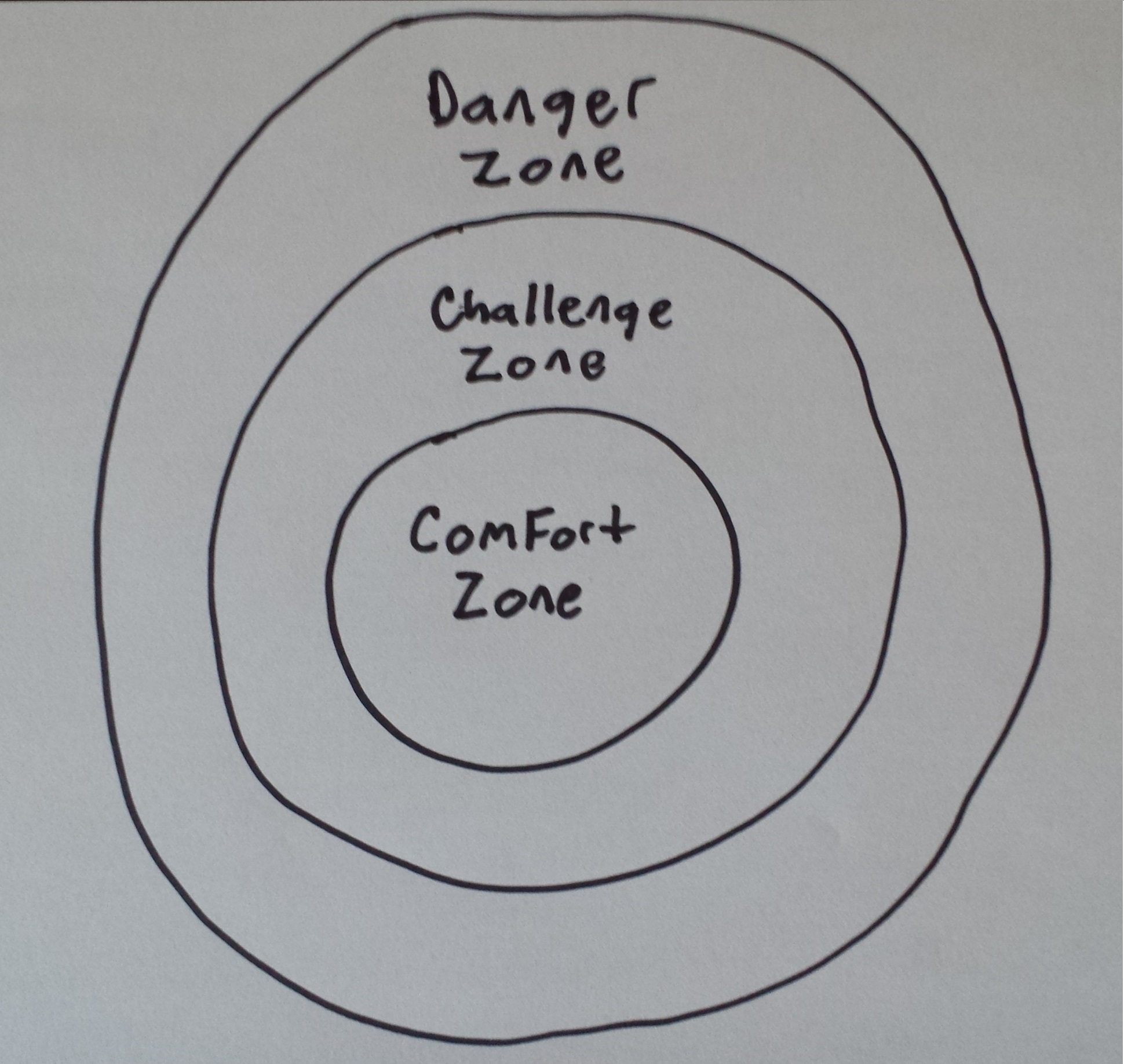
I think there are 3 sections relating to our Comfort Zone that look like the following:

ComfortZoneGraphic-4-Jul-15

The characteristics of each section are as follows:

Our Comfort Zone:

  • Things you attempt are easy to accomplish
  • Success is almost certain
  • This space can expand as we master items in our Challenge Zone

Our Challenge Zone:

  • Things in this zone represent endeavors we have not yet attempted, or are in the early stages of trying
  • Success is not certain, but is likely with practice and continued effort
  • Mastery of items in this zone causes those items to move out of our Challenge Zone and into our expanded Comfort Zone

Our Danger Zone:

  • Items in this space represent skills or talents we do not yet , or may never, possess
  • Outcomes are disastrous at best; dangerous at worst
  • Items in this space can move into our Challenge Zone, and even our Comfort Zone, but only after significant effort, failure, and disciplined practice; it is a slow process

When we step out of our Comfort Zone, we should look for those items that lie within our Challenge Zone, perhaps those items close to, but not exceeding, the far edge of our Challenge Zone.  These items are the ones that will stretch us the most and cause the most rapid growth.

Take for example, a person who wants to be an airline pilot who has never flown an airplane before.  They would not start out flying a 500+ passenger aircraft for a major airline.  That would certainly be in their Danger Zone and would have disastrous consequences.  They’d first start out learning to fly small single engine airplanes.  Initially, this would be something that would be in their Challenge Zone, but as they spend time with a flight instructor, they would eventually develop mastery in this area.  At that point, flying small single engine aircraft would be in their Comfort Zone and they would be ready to move to move up to the next larger aircraft that is in their Challenge Zone.  They would continue learning to become familiar with increasingly complex aircraft, until that 500+ passenger aircraft has moved from their Danger Zone into their Challenge Zone.  At that point, they would begin training in that aircraft, until its mastery, which was once in their Danger Zone, becomes part of their Comfort Zone.

Moving items from the Danger Zone to the Comfort Zone is a process that is usually timely and slow, so patience and discipline is required.

What items would you like to add to your Comfort Zone?  What item in your Challenge Zone can you begin working on today to move you one step closer to its mastery and an eventual placement in your Comfort Zone?  Don’t wait!  Get started today and begin seeing your Comfort Zone expand as you achieve things you never thought possible.

The Clairity from Writing it Down

I’ve recently got back into the habit of daily journaling and have been amazed at the positive impact this discipline has on me.

When I journal, I often write about improvements I want to make in my life and what I’m’ currently struggling with or working toward.  The exercise of giving thought to a topic and spending several minutes putting these thoughts on paper give me the following:

  • Clarity of direction
  • New ideas
  • A way to process and organize my unformed thoughts

When I don’t journal, I find I only spend a few brief minutes each day thinking about what I’m working on, pursuing, or struggling with.  This brief, unfocused thinking always leaves me void of any real plan or direction I can take to make progress in that day.  However, when I journal, especially in the morning before the day gets started, I gain a clarity about whatever issue I’ve written about, but more important, I feel energized and eager to jump in and get the day started.

If you’re considering the practice of daily journaling, here are 3 suggestions that I find helpful:

  • Pick a consistent time every day. Do mornings work best for you or evenings before bed?  Perhaps around lunch time works best.  It doesn’t matter at all what time you journal.  What does matter is that you find a time that you can commit to as much time as you need to journal, whether it’s 5 minutes or an hour.  Find what works for you.
  • Find a journal that you like the feel of. This may seem like a funny thing, but the journal you right on must “feel” right.  Does it fit well in your hand or on your lap?  Do you like pages with lines or blank pages?  Do you prefer a spiral binding, a yellow note pad, or leather bound journal?  I prefer a smaller size page (because it feels like I write more) and I also prefer a journal that lays open nicely.  It doesn’t matter what your preference is, as long as your journal feels right for you.  It should be something you want to spend time with.
  • Write about topics that interest you. I mentioned above how I like to write about what I’m working on our struggling with, but that doesn’t have to be what you write about.  Maybe you want to write about what you did that day, or keep a list of ideas, or record significant events.  Perhaps you just want to write about whatever is on your mind.  Those are all great topics! As long as you’re writing about something that is interesting to you, you’ve got the right topic.

Of these suggestions, I think that finding a consistent time to write is the most important to maintaining consistency.

If you want to increase the clarity of thinking,  make significant progress toward achieving your goals, or just be more mindful of what direction you’re leading your life, I suggest giving journaling a try.  Your writing doesn’t have to be eloquent, flowery or even grammatically correct.  It just has to be a written expression of whatever is on your mind.

Getting from Here to There

From the perspective of achieving your goals, getting from where you are to where you want to be can often feel overwhelming.  Especially if we’re unsure about the steps we need to take to get there.  The following visual exercise can be very helpful in gaining clarity on what we need to do to start moving forward.

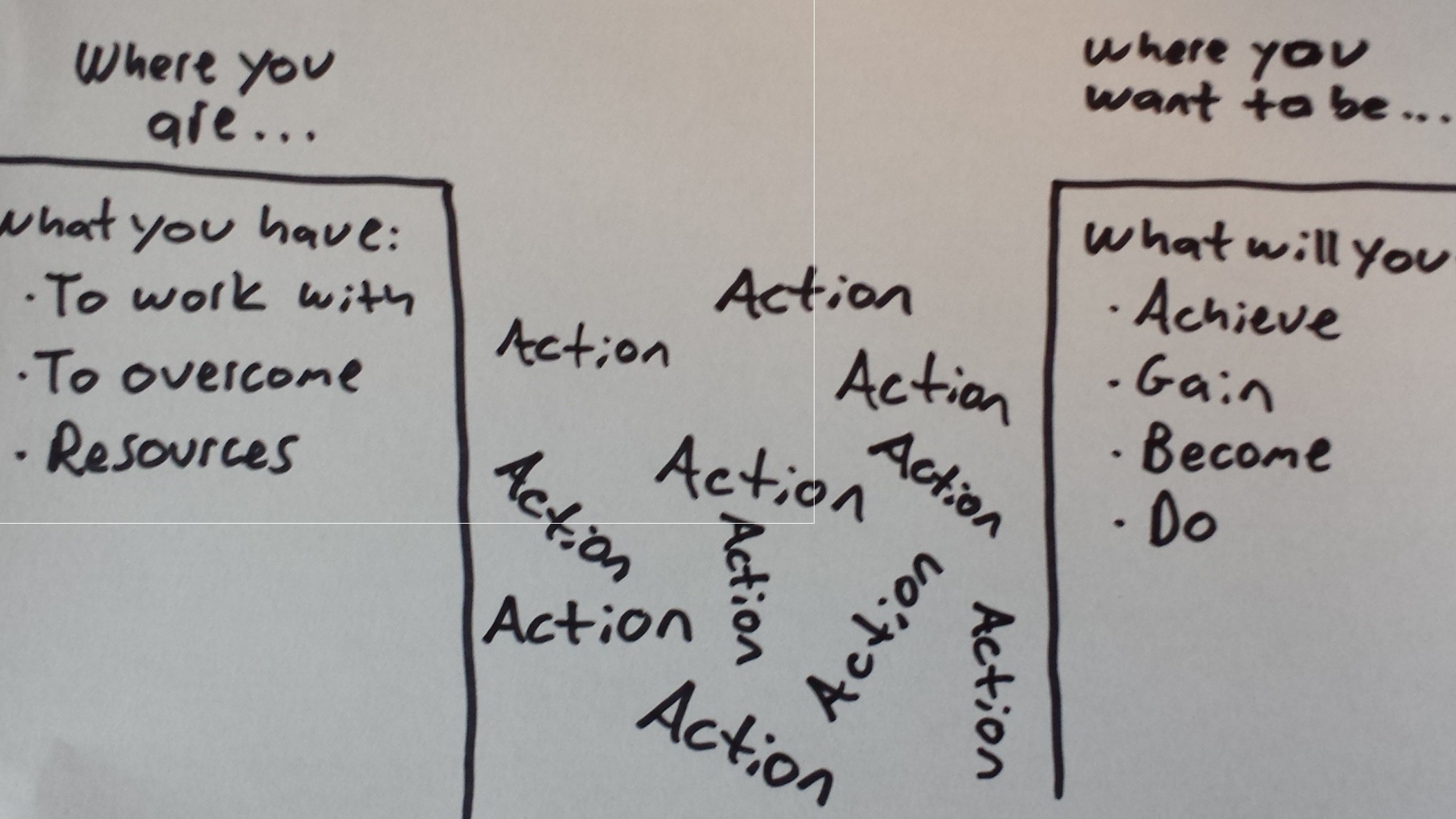
First, make a write in where you are, and where you want to be, as shown below.

Step 1

Second, on the left side of the page, fill in what you currently have in the way of resources and things to work with and overcome.  This gives you a starting point.  On the right side of the page, note what you will have once you achieve your goal.  This will help provide motivation, clarity, and direction.

Step 2

Next, think of all the major tasks you need to take to get from where you are to where you want to be.  The list doesn’t even have to be in order, or 100% complete.  Just start thinking of all the tasks that you need to do and list them in the gap on the page between where you are and where you want to be.

Step 3

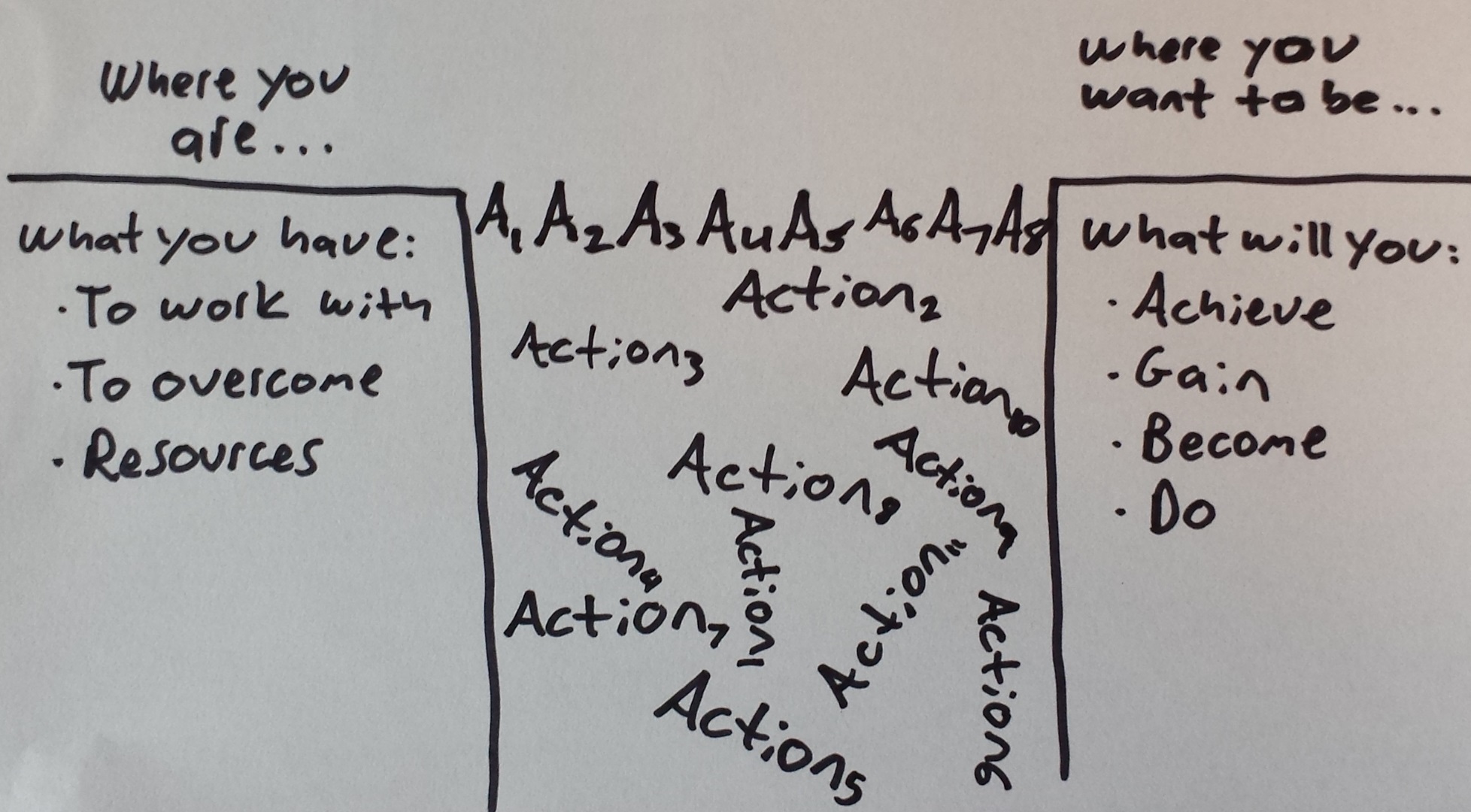
At this point we know where we are, where we want to be, and a bunch of tasks that need to be done to get there.  The next step is to number the tasks in the order we need to complete them.  This is where our action plan gets created.  When you’re done with this step, you should have a plan to bridge the gap between where you are and where you want to be.

Step 4

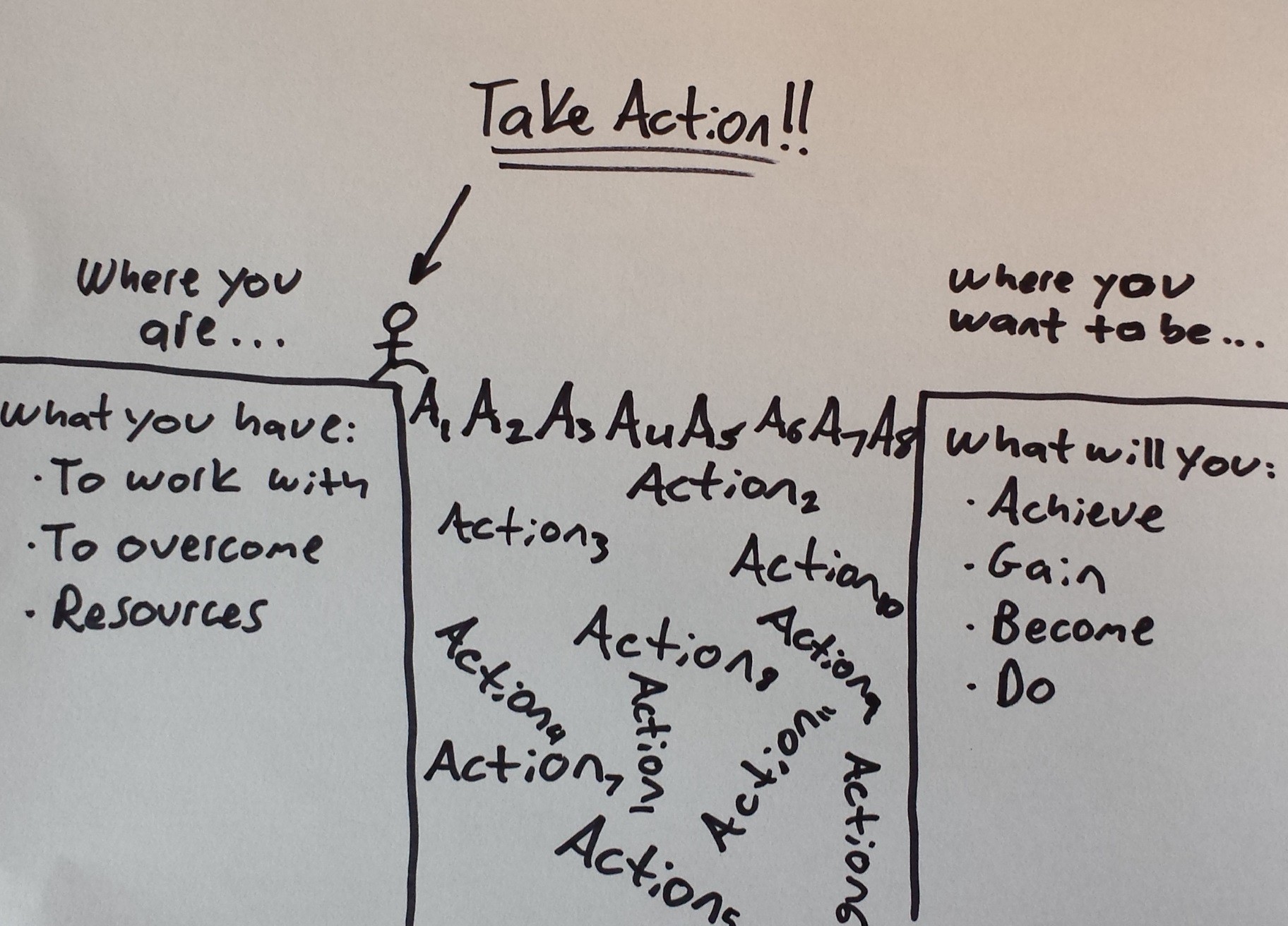
Now, we come to the most important step in the process:  TAKE ACTION!  The best plan is useless until we take action toward implementing it.

Step5

If you’ve got a goal you’d like to achieve, but need a plan on how to achieve, try this simple exercise.  It will give you clarity on what needs to be done, and motivation to see what you’re moving toward.

Just remember that the most important thing you can do, once you’ve completed the plan, is take action.  Your goals are waiting.  Start today.