Your Comfort Zone and Beyond               

We all know that in order to stretch and grow we must consistently get out of our Comfort Zone.  But just how far out of our Comfort Zone should we be going?  Is there a limit?

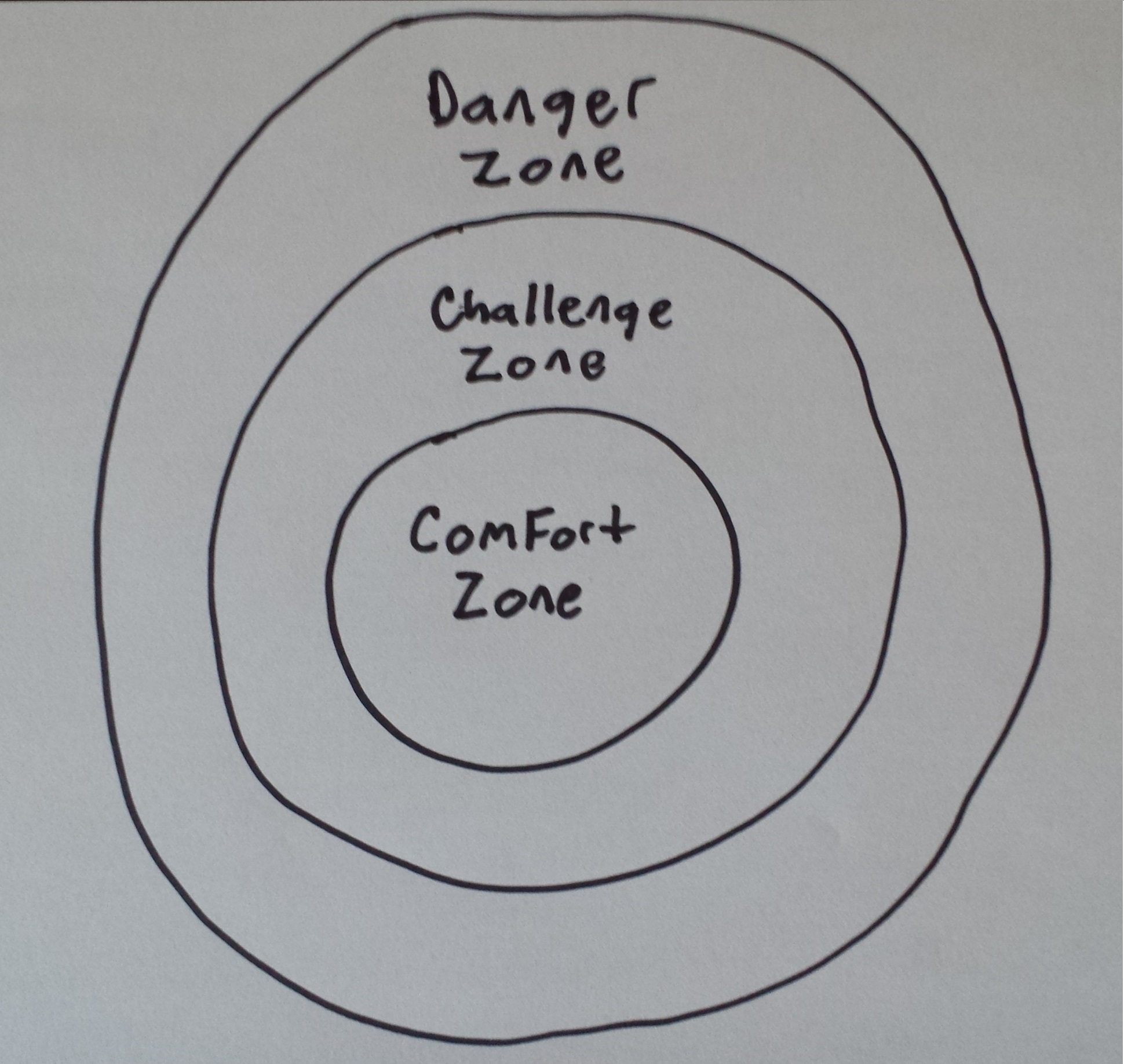
I think there are 3 sections relating to our Comfort Zone that look like the following:
ComfortZoneGraphic-4-Jul-15

The characteristics of each section are as follows:

Our Comfort Zone:

  • Things you attempt are easy to accomplish
  • Success is almost certain
  • This space can expand as we master items in our Challenge Zone

Our Challenge Zone:

  • Things in this zone represent endeavors we have not yet attempted, or are in the early stages of trying
  • Success is not certain, but is likely with practice and continued effort
  • Mastery of items in this zone causes those items to move out of our Challenge Zone and into our expanded Comfort Zone

Our Danger Zone:

  • Items in this space represent skills or talents we do not yet , or may never, possess
  • Outcomes are disastrous at best; dangerous at worst
  • Items in this space can move into our Challenge Zone, and even our Comfort Zone, but only after significant effort, failure, and disciplined practice; it is a slow process

When we step out of our Comfort Zone, we should look for those items that lie within our Challenge Zone, perhaps those items close to, but not exceeding, the far edge of our Challenge Zone.  These items are the ones that will stretch us the most and cause the most rapid growth.

Take for example, a person who wants to be an airline pilot who has never flown an airplane before.  They would not start out flying a 500+ passenger aircraft for a major airline.  That would certainly be in their Danger Zone and would have disastrous consequences.  They’d first start out learning to fly small single engine airplanes.  Initially, this would be something that would be in their Challenge Zone, but as they spend time with a flight instructor, they would eventually develop mastery in this area.  At that point, flying small single engine aircraft would be in their Comfort Zone and they would be ready to move to move up to the next larger aircraft that is in their Challenge Zone.  They would continue learning to become familiar with increasingly complex aircraft, until that 500+ passenger aircraft has moved from their Danger Zone into their Challenge Zone.  At that point, they would begin training in that aircraft, until its mastery, which was once in their Danger Zone, becomes part of their Comfort Zone.

Moving items from the Danger Zone to the Comfort Zone is a process that is usually timely and slow, so patience and discipline is required.

What items would you like to add to your Comfort Zone?  What item in your Challenge Zone can you begin working on today to move you one step closer to its mastery and an eventual placement in your Comfort Zone?  Don’t wait!  Get started today and begin seeing your Comfort Zone expand as you achieve things you never thought possible.

Getting from Here to There

From the perspective of achieving your goals, getting from where you are to where you want to be can often feel overwhelming.  Especially if we’re unsure about the steps we need to take to get there.  The following visual exercise can be very helpful in gaining clarity on what we need to do to start moving forward.

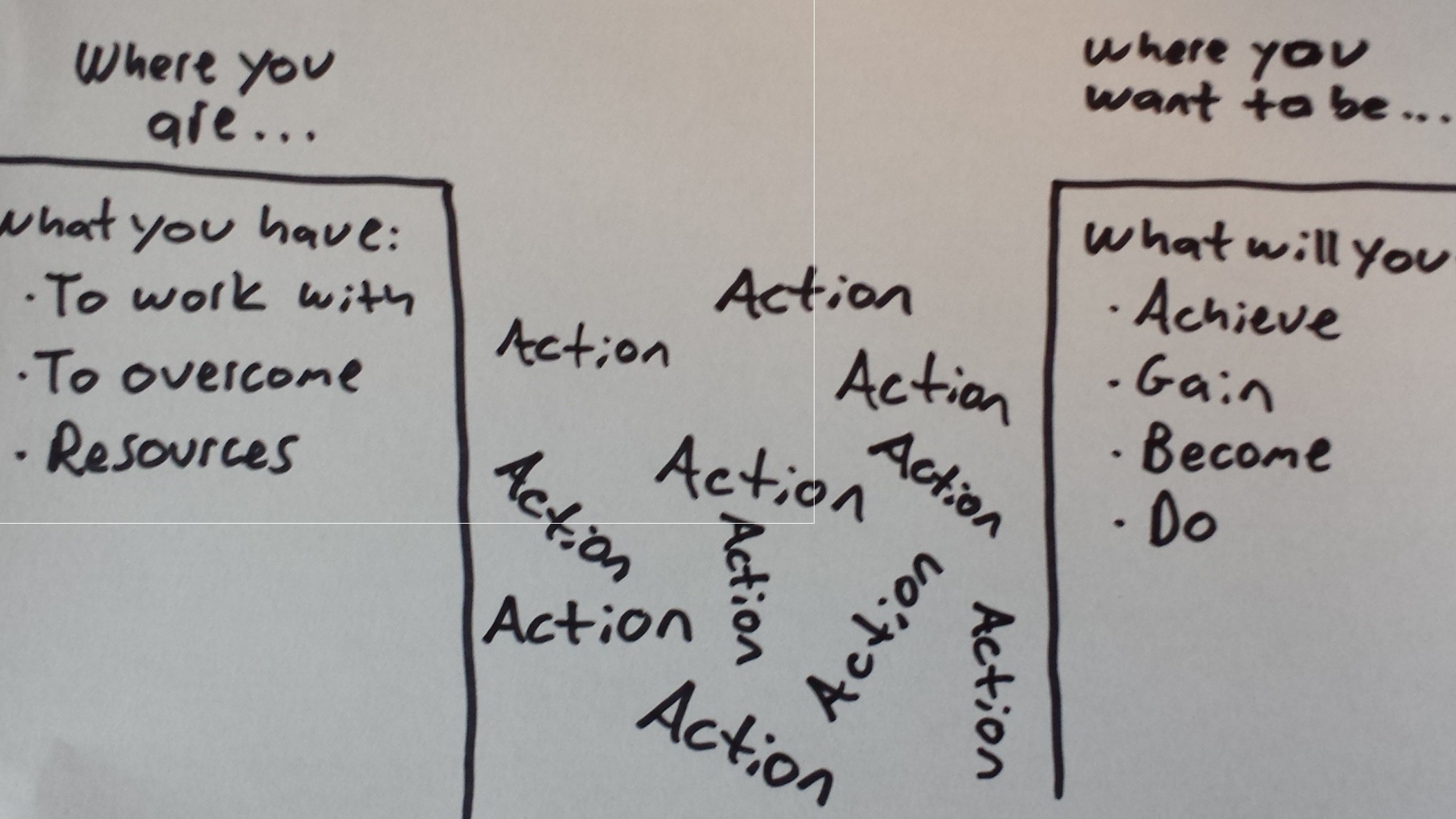
First, make a write in where you are, and where you want to be, as shown below.

Step 1

Second, on the left side of the page, fill in what you currently have in the way of resources and things to work with and overcome.  This gives you a starting point.  On the right side of the page, note what you will have once you achieve your goal.  This will help provide motivation, clarity, and direction.

Step 2

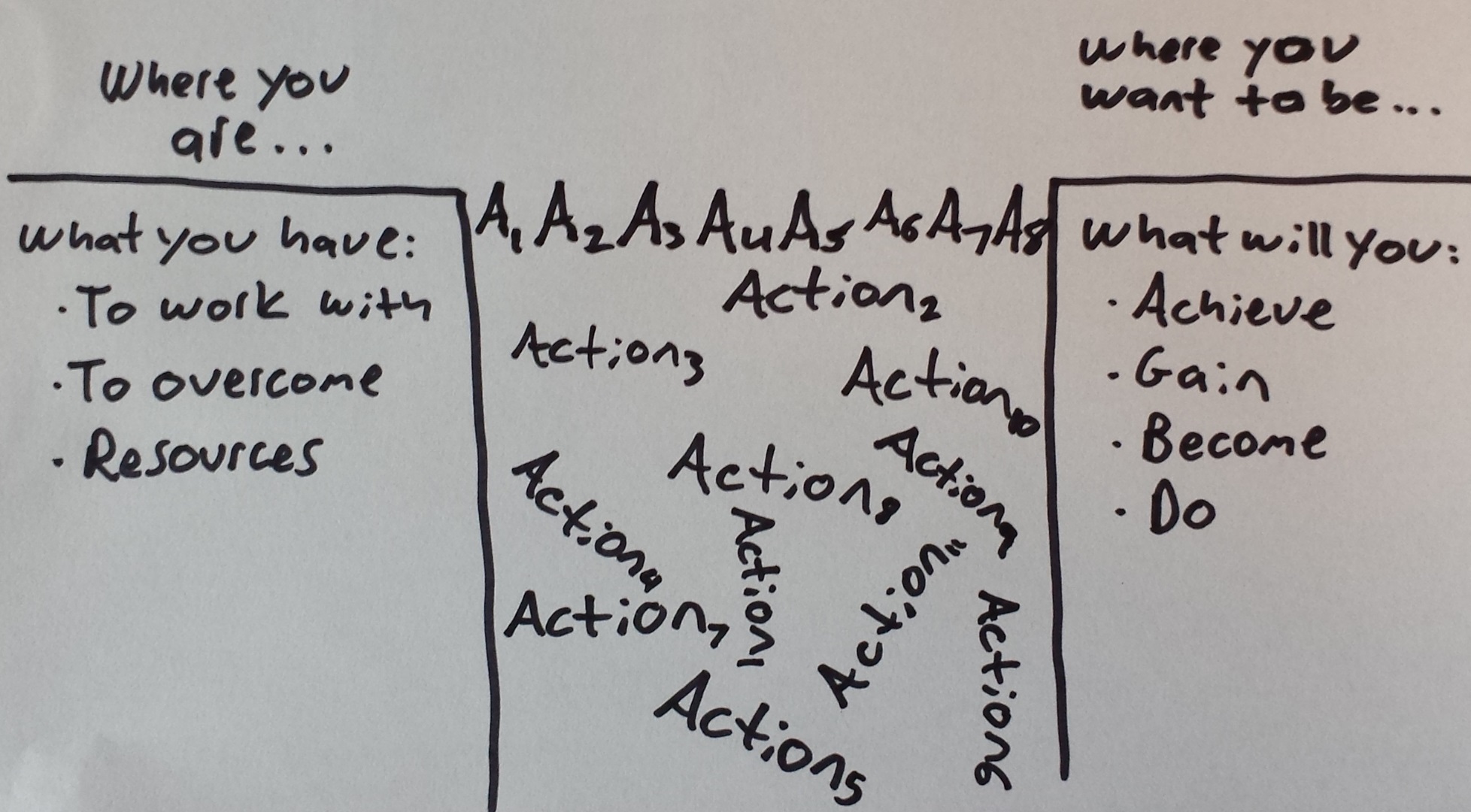
Next, think of all the major tasks you need to take to get from where you are to where you want to be.  The list doesn’t even have to be in order, or 100% complete.  Just start thinking of all the tasks that you need to do and list them in the gap on the page between where you are and where you want to be.

Step 3

At this point we know where we are, where we want to be, and a bunch of tasks that need to be done to get there.  The next step is to number the tasks in the order we need to complete them.  This is where our action plan gets created.  When you’re done with this step, you should have a plan to bridge the gap between where you are and where you want to be.

Step 4

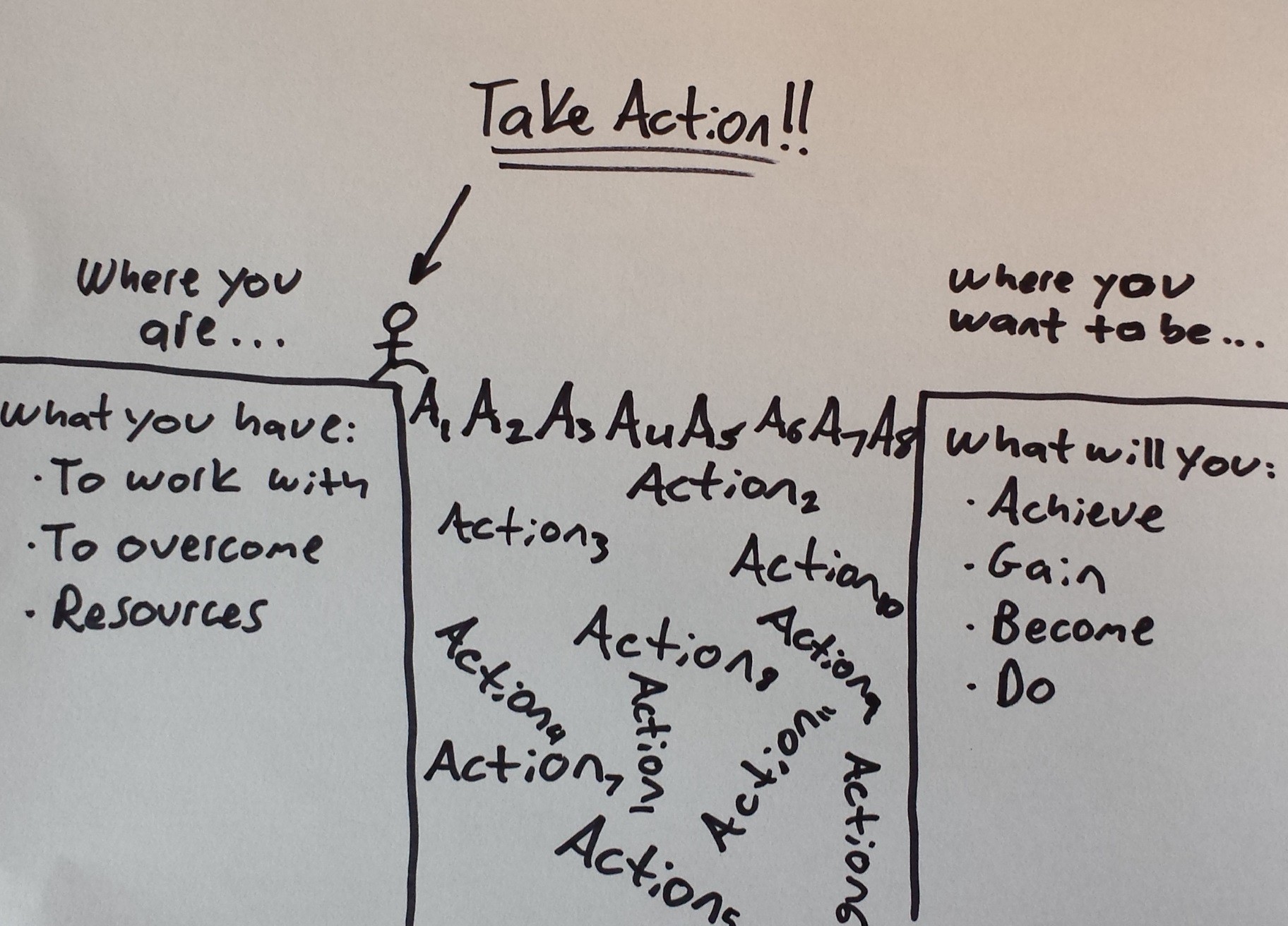
Now, we come to the most important step in the process:  TAKE ACTION!  The best plan is useless until we take action toward implementing it.

Step5

If you’ve got a goal you’d like to achieve, but need a plan on how to achieve, try this simple exercise.  It will give you clarity on what needs to be done, and motivation to see what you’re moving toward.

Just remember that the most important thing you can do, once you’ve completed the plan, is take action.  Your goals are waiting.  Start today.

Does it Really Matter

Does it really matter if today you:

  • Exercise or go to the gym
  • Eat a healthy diet
  • Zone out in front of the TV all night instead of doing something more productive
  • Hold a grudge
  • Spend time improving yourself through reading and study
  • Neglect the most important relationships in your life
  • Complain about things that aren’t going well in your life

My response is, no.  In the big scheme of things, it doesn’t really matter if you did one or all of those things today.  In fact, I would even argue that it likely wouldn’t matter much if you did or didn’t do all of those things for a whole week.

But eventually, it will matter.

Suppose you want lose a few pounds and be healthier, so today to start eating better and exercising.  At the end of today, after you’ve eaten well and exercised, are you going to notice a significant difference?  Will you be healthier and at your desired weight?  No, you won’t.   You’ll look the same as you did the day before.  It’s likely you won’t even notice much of a difference after a week.  This is a point where people become frustrated, and often give up on a long term goal; when significant results don’t immediately follow effort.

However, if you stick with your plan to eat well and exercise every day, after 365 days, you’re going to notice a big difference.  At the end of the year you will undoubtedly look and feel much different, and better, than you did 365 days ago.

Now suppose at the end of 365 days of sticking with your plan I was to ask you, “So which day out of the last 365 days caused you to achieve the results you’re enjoying today?”  You might say it was the day you decided to take action, to which I would absolutely agree.  But if I pressed, to know which specific day’s effort made all the difference, your answer would be:  they all did.

Likewise, suppose you’re in good shape and living a healthy lifestyle, but you decide to skip working out today and also to eat foods that aren’t the healthiest.  Will this day totally ruin your health?  No.  If you return to your healthy lifestyle tomorrow, will this one day’s activity even make a dent in the big picture of your health?  No, it won’t.  But, if you continue this habit for 365 days, you’ll also see significant results in the deterioration of your health.

It’s the compounding effect of our consistent actions that yield results in our life, both positive and negative.  This compounding is at play shaping all areas of our lives:  health, relationships, career, personal development, finances, and attitude.

Is there any area in your life where you’d like the compounding effect to work for your benefit to achieve results you’re looking for?  If so, begin by following this simple checklist:

  1. Think about the change you’d like to make, and what your life looks like as a result of this change.
  2. Determine the actions you need to take today to achieve your desired result.
  3. Take those actions.
  4. Go through all 4 steps in this checklist again tomorrow.

We’re all building something with our lives, and the compounding effect is a significant principle that will yield powerful results, both positive and negative.

So decide today to put the compounding effect to work for you by providing consistent actions that will yield the results you’re after.  And if you mess up or miss a day, don’t be too hard on yourself, and certainly don’t give up as a result.  Just recommit the next day, and get back to providing the consistent effort that will be rewarded by the compounding effect; because it really does matter.

The Secret Ingredient

I believe there is a not-so-secret ingredient to achieving results in any area of your life.  Before I share this not-so-secret ingredient, let’s first review the other necessary ingredients in the proven formula for achieving results:

Vision + Knowledge + ? = Results

The first 2 components of the formula make sense, right?  Without a vision of the result you want, it would be challenging to even know where to begin.  We must first know where we’re going (know the result we seek) before we can move toward its achievement.

Likewise, we must also possess the knowledge required to achieve the results we want.  A vision will only prove frustrating if we lack the requisite knowledge for its attainment.

So, you’re probably wondering, “What is the secret ingredient you say I need in order to achieve results?”  The complete formula for achieving results is:

Vision + Knowledge + ACTION = Results

Does that secret ingredient leave you feeling dissatisfied?  Were you perhaps expecting something more exciting and grand?  The truth is, any results or success we seek only come through the disciplined and consistent application of action.  We’re not talking about action that fills our time and causes us to appear busy, but rather specific actions that move us closer to our desired results.

Very often, this is the step that trips people up.  If we’re honest with ourselves, we usually know the necessary action we should be taking to achieve the results we want.  We simply need to be courageous enough to take the action we already know we should.  We need to cause something to happen.

What results are you trying to achieve that could use a healthy dose of necessary action?  You probably already know what action you need to take.  So… when will you take it?  Today would be a good day to start.

Don’t delay.  Results await!

Swing for the Fence

Imagine you’re on a baseball team and it’s your turn to bat.  You’ve been practicing at the batting cage, and you’ve become quite good; not to mention, you enjoy batting.  Could you imagine saying to your coach, “You know what, Coach?  I don’t know if I’m ready for this.  What if I strike out?  I think I’ll skip my turn and go back to the comfort and security of the batting cage and let someone else bat instead.”

That would be ridiculous, right?  Who would do that?!

I would argue that we may be guilty of doing something similar when we doubt or play down our abilities in the face of opportunities that would grow and stretch us out of our comfort zone.

It’s easy to wish for opportunity, or even seek it out, in the comfort of the daily routine.  However, when an opportunity actually presents itself, we often begin doubting our abilities and whether we’re really capable of being successful.  We wonder if we are capable of rising to the challenge, or if maybe we’re really not as good as we, or others, might think.

It’s totally normal to have some doubts or be nervous about taking on a new and challenging opportunity.  However, what’s tragic is when we decide not to pursue an opportunity we’re capable of either out of fear of failing or because we doubt our own proven skills and ability.

I heard a quote recently that stated:

“In 20 years we won’t be disappointed by the things we did to; we’ll be most disappointed by the things we didn’t do.”

The next time you’re presented with an opportunity that will stretch you and your abilities, grab your bat, step up to the plate, and swing for the fence!  Take the risk.  Step out of your comfort zone and into the challenge, and give it your best shot.  And if you happen to fail, which you most likely will NOT, at least you’ll go down swinging.

Always remember: No Grand Slam home runs have ever been hit from the safety and security of the batting cage.

Comfort and Order

“Humans are designed to seek comfort an order, and if they have comfort and order, they tend to plant themselves, even if their comfort isn’t all that comfortable.  And even if they secretly want something better”

Donald Miller

A Million Miles in a Thousand Years


I was half way through Donald Miller’s book (pg. 100) when I read those words above.  I found them to be both haunting and eye-opening.  They’re haunting, because I’ve been in this exact scenario for many years, and eye-opening, because it finally feels like the root cause to one of my primary struggles has been revealed.

I find it extremely easy to put off making a change when I’m comfortable or complacent in my current situation.  I’ve been struggling with making a career change for many years.  I currently work in Information Technology, but my preference is to work with people, rather than with hardware, software, and systems.  I’ve wanted to make a change for several years, but I’ve made minimal progress.  Often, weeks or months go by without me having done one thing to move closer to a new career.  I know what I’d like to be doing, but I find it easy to put off taking action, primarily because my current situation isn’t all that bad.  It’s comfortable enough to keep me from taking decisive action toward bringing about the career change I desire.

I knew this, to a certain degree, about myself, and could observe this scenario in my own life.  However, reading Miller’s words, that so clearly articulate this concept, it felt like a harsh slap or glass of cold water thrown in my face.  As if my mind was screaming, “He’s describing you!”

After reading those words, I’ve been keenly aware when I’m letting comfort and complacency chart my course.  It gets me fired up, because I can’t think of a single time in my life when I was driven by comfort and complacency, that it ever led me anywhere significant.

How about you?  Are there any areas in your life where you’re actions, or lack of actions, are being driven by the desire to maintain comfort and order?  Is the desire for comfort and order taking you where you really want to go in life?  If you’re struggling in this area, join me in taking the following actions:

  1. When you feel yourself being motivated by the desire to maintain comfort, acknowledge it. Call it out right there on the spot and say, “I’m not letting comfort chart my course any longer!”
  2. Think about the next step you need to take toward a goal or path you’ve set.
  3. Take that next step. It doesn’t matter how small a step it is; take it!
  4. Repeat the process as often as necessary

I don’t think we were designed to live lives that were above all, comfortable.  I think we’re at our best when we’re growing, improving, and pursuing the goals we’ve set for ourselves.

Decide today to stop letting comfort keep you from pursuing a remarkable, fulfilling life.  All you have to lose is the discomfort of being comfortably stuck.

The Intersection

On Monday evening January 12th Ohio State played the University of Oregon for the College Football National Championship in Dallas Texas.  What struck me most about the game was not the score or the collective ability of each team, but the very clear life lesson that was on display during the game.  The lesson was that great things happen at the intersection of preparation and opportunity.

Although I was rooting for the University of Oregon, myself being from Oregon, I was really impressed with the performance of the Ohio State quarterback Cardale Jones.

Consider this:

  • The National Championship game was only his the 3rd college start as quarterback
  • At the beginning of the season, he was the 3rd string quarterback on his team

I was amazed by these facts while watching the game.  While on the biggest stage in college football, Jones showed the command and poise of a seasoned quarterback.  He didn’t look like a 3rd string quarterback, or someone who had only started 3 games.  He looked like he belonged there.  Was he perfect?  No.  Did he make mistakes?  For sure!  However, he was able to step in for his team when his number was called late in the season and perform extremely well.  Well enough to help win a National Championship.

It is obvious from his performance that he had been practicing and preparing for the opportunity.  His preparation intersected with his opportunity, and great things happened.

If Jones hadn’t been diligent in practice while he was still the 3rd string quarterback, he never would have done so well when he got the nod to lead the offense.  Imagine what a different outcome Jones would have had if he had said, “Once I’m the starting quarterback, then I’ll really start practicing!  However, since I’m only the 3rd string, there’s really no point in doing my best at practice.”  Jones had great performances during his 3 starts because he put in the effort to prepare himself in practice; to be ready for the opportunity, even when he didn’t see one or know that one was coming.

What about you?  Are there areas where you need to begin preparing for a future opportunity?  Is there a class you need to take, a habit or discipline you need to develop or stop?  Is there a reading, networking, exercise, or eating plan you need to get on?  If so, begin today.  Don’t’ delay and think, “I’ll start preparing when I see an opportunity.”  That kind of thinking leaves out half of the intersection equation:  There can be no greatness-causing intersection between preparation and opportunity if opportunity shows up alone.

So begin preparing today for the opportunities you seek in the future.  My guess is that, if you’re preparing, the opportunities are closer than you think.

What Football Can Teach Us About Goal Setting – Part 2

There was some good college bowl games played on New Year’s Day 2015!  Ohio State and Alabama played a close game in the Sugar Bowl that went down to the last play, and Oregon dismantled Florida State in the Rose Bowl, breaking a Florida State 29 game winning streak in the process.  Despite the differences in each game, there was one aspect that was exactly the same:  Each team knew the significance of the goal line.

I love the name:  “goal line”.  It very clearly states the objective of the entire game for each team, no matter what side of the ball they’re on.  For the offense, the objective is to cross the goal line and score points for your team.  For the defense, the objective is to keep your opponent from crossing the goal line and scoring.

The goal line is a very clearly defined critical reference point that each team is striving to cross or protect.  There is no question from anyone, on either team, as to the objective of the game and the goal they’re working toward.

Imagine if there was no goal line in football.  The game would be confusing and chaotic, with no one really knowing what they were supposed to be doing or what the objective of the game was.  It can be like that in our own lives without clearly defined goals.  If we don’t know what goal lines we want to cross for our lives in 2015, we will be unclear and confused as to our daily direction.  In addition, unless we’re content just drifting through the year like a leaf in a stream, going wherever the current takes us, we’re going to be disappointed on December 31st 2015 when we realize we haven’t made any progress or significant changes in our life.

What goal lines have you defined for yourself for 2015?  Do you know what you’re moving toward achieving throughout 2015?   If so, great!  Begin taking steps every day to move ever closer to crossing your goal line.  If you haven’t determined what your goal lines for 2015 are, it’s not too late.  Spend some time deciding what you’d like to accomplish this year and clearly define what success in those areas looks like for you.  The definitions you create will be your goal lines.  Your objective for the year will be to make incremental progress toward crossing them.

Where Do You Want to be on December 31st

Are you looking to make significant changes in any area of your life in 2015?  If so, seriously consider the following question:

What do you want your life to look like on December 31st 2015?  

This is not only a great question, it’s also a great goal setting starting point, because it causes us to really think about how we’d like our life to look in 12 months, and gives us a target to shoot for throughout the year.  With this vision firmly planted in our mind, we can move backwards and determine what steps we need to take, and by when, in order to arrive at our desired life in 12 months.

As you start your goal setting and life planning for 2015, begin by creating a very clear and measurable picture of how you’d like your life to look on December 31st 2015.  Hold this picture in mind all year.  Do whatever you can to keep it in the front of your thoughts.  Use it to intentionally guide your behaviors and decision making which in order to cause you to arrive at the life you desire 12 months from now.

Know where you’re going in 2015, and take the necessary steps to get there.

Happy New Year!