Be Curious

A couple of weeks ago I went to listen to a lecture by Brent McGregor, a photographer and ice cave explorer who has done significant work on Oregon’s Mt. Hood.  I expected to learn a lot about ice caves on Mt. Hood, which I did, but I was surprised by what, for me, was the biggest take-away from his talk.

His lecture was extremely interesting, and the pictures and video he presented were breathtaking.  What was most interesting to me however was that Brent came to ice-caving later in life, and has been able to have significant impact on ice cave research and exploration in such relatively short time.

This encourages me, because I’m reminded that no matter our age, we still have the capacity to be curious and interested in new things.  We also have the ability, and privilege, to pursue those things that interest us.

Fortunately, there is no age where we are no longer allowed to be curious or interested.  The only limits to our curiosity are the ones we place upon ourselves.

Go out and be curious.

The Clairity from Writing it Down

I’ve recently got back into the habit of daily journaling and have been amazed at the positive impact this discipline has on me.

When I journal, I often write about improvements I want to make in my life and what I’m’ currently struggling with or working toward.  The exercise of giving thought to a topic and spending several minutes putting these thoughts on paper give me the following:

  • Clarity of direction
  • New ideas
  • A way to process and organize my unformed thoughts

When I don’t journal, I find I only spend a few brief minutes each day thinking about what I’m working on, pursuing, or struggling with.  This brief, unfocused thinking always leaves me void of any real plan or direction I can take to make progress in that day.  However, when I journal, especially in the morning before the day gets started, I gain a clarity about whatever issue I’ve written about, but more important, I feel energized and eager to jump in and get the day started.

If you’re considering the practice of daily journaling, here are 3 suggestions that I find helpful:

  • Pick a consistent time every day. Do mornings work best for you or evenings before bed?  Perhaps around lunch time works best.  It doesn’t matter at all what time you journal.  What does matter is that you find a time that you can commit to as much time as you need to journal, whether it’s 5 minutes or an hour.  Find what works for you.
  • Find a journal that you like the feel of. This may seem like a funny thing, but the journal you right on must “feel” right.  Does it fit well in your hand or on your lap?  Do you like pages with lines or blank pages?  Do you prefer a spiral binding, a yellow note pad, or leather bound journal?  I prefer a smaller size page (because it feels like I write more) and I also prefer a journal that lays open nicely.  It doesn’t matter what your preference is, as long as your journal feels right for you.  It should be something you want to spend time with.
  • Write about topics that interest you. I mentioned above how I like to write about what I’m working on our struggling with, but that doesn’t have to be what you write about.  Maybe you want to write about what you did that day, or keep a list of ideas, or record significant events.  Perhaps you just want to write about whatever is on your mind.  Those are all great topics! As long as you’re writing about something that is interesting to you, you’ve got the right topic.

Of these suggestions, I think that finding a consistent time to write is the most important to maintaining consistency.

If you want to increase the clarity of thinking,  make significant progress toward achieving your goals, or just be more mindful of what direction you’re leading your life, I suggest giving journaling a try.  Your writing doesn’t have to be eloquent, flowery or even grammatically correct.  It just has to be a written expression of whatever is on your mind.

Getting from Here to There

From the perspective of achieving your goals, getting from where you are to where you want to be can often feel overwhelming.  Especially if we’re unsure about the steps we need to take to get there.  The following visual exercise can be very helpful in gaining clarity on what we need to do to start moving forward.

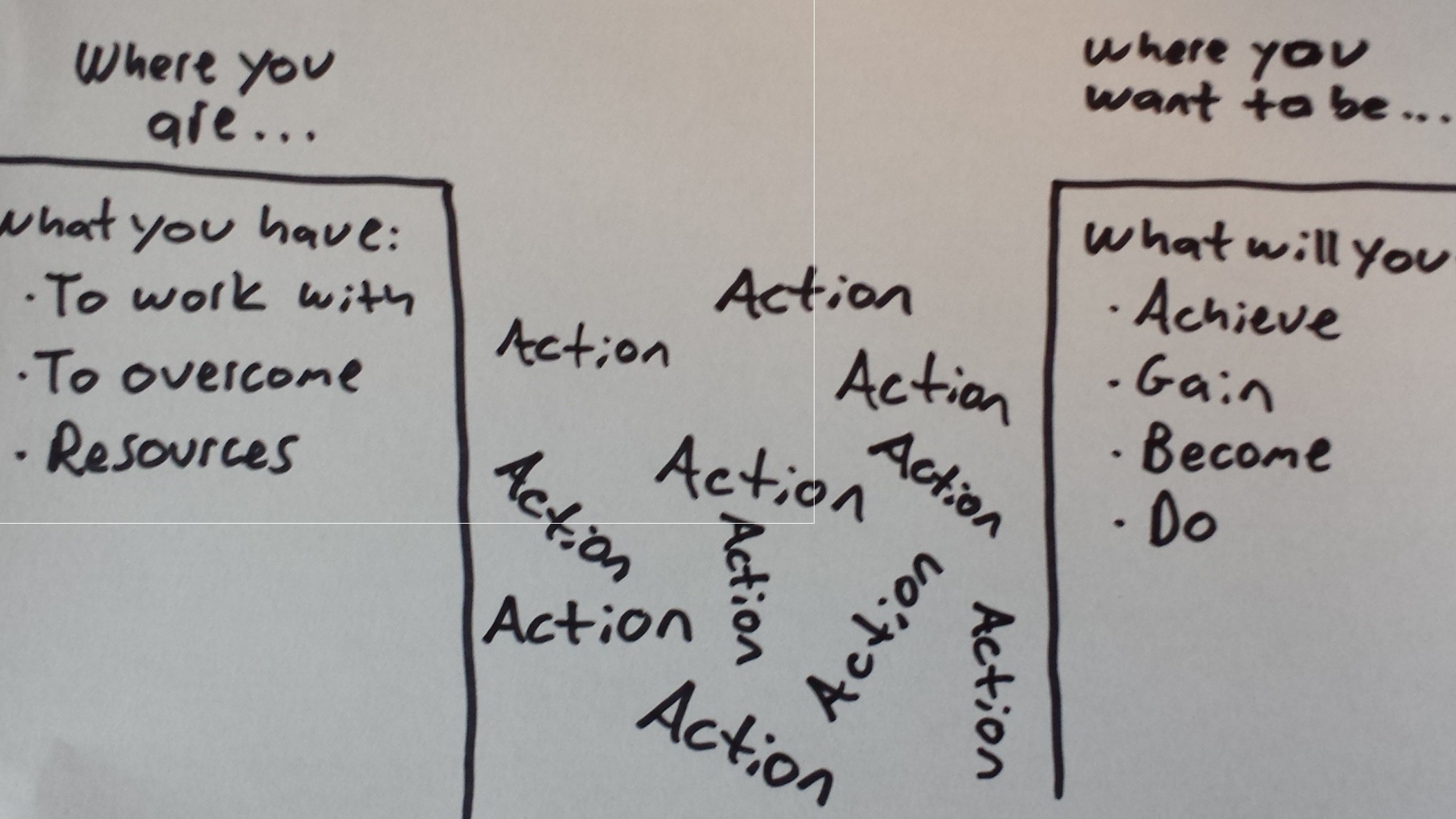
First, make a write in where you are, and where you want to be, as shown below.

Step 1

Second, on the left side of the page, fill in what you currently have in the way of resources and things to work with and overcome.  This gives you a starting point.  On the right side of the page, note what you will have once you achieve your goal.  This will help provide motivation, clarity, and direction.

Step 2

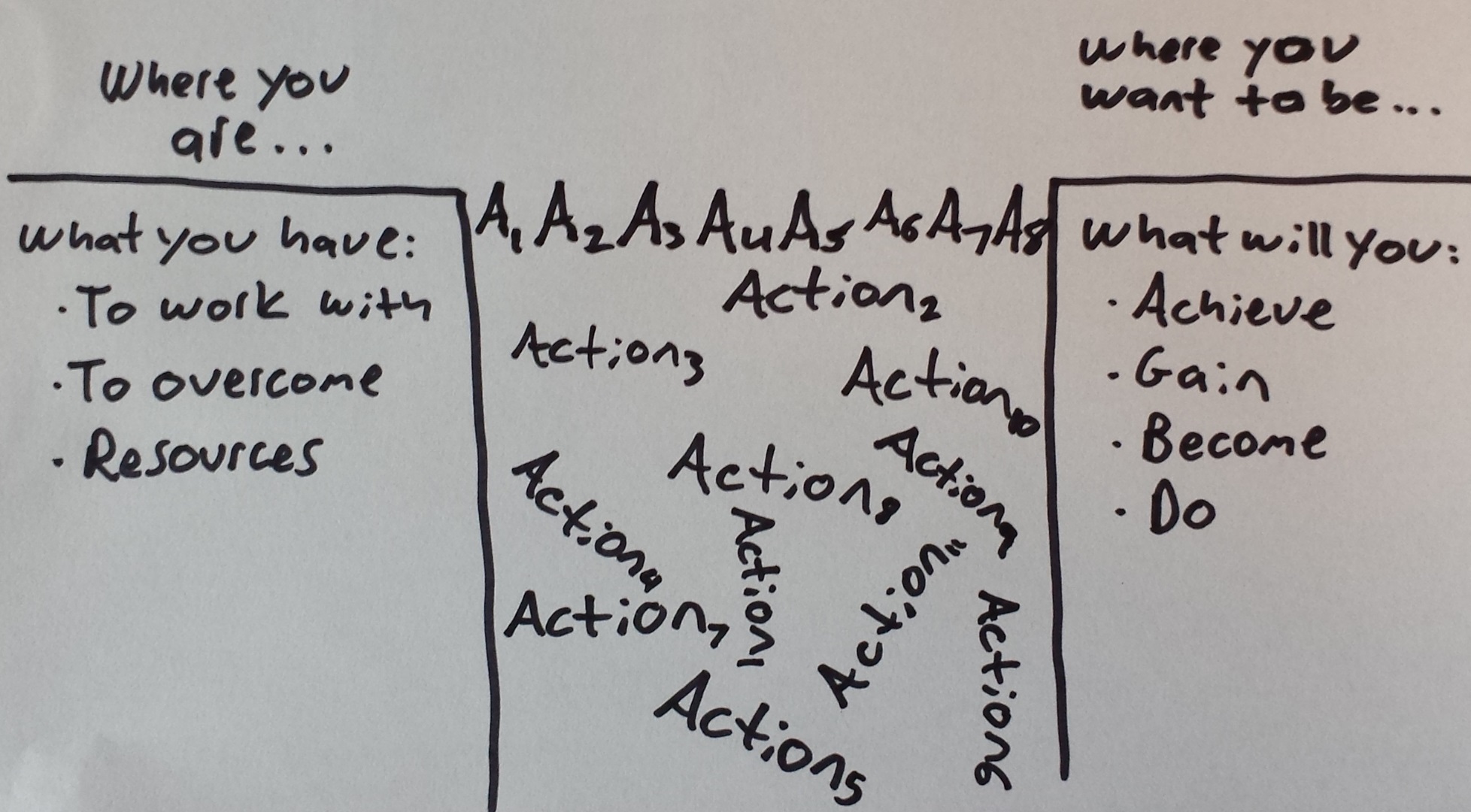
Next, think of all the major tasks you need to take to get from where you are to where you want to be.  The list doesn’t even have to be in order, or 100% complete.  Just start thinking of all the tasks that you need to do and list them in the gap on the page between where you are and where you want to be.

Step 3

At this point we know where we are, where we want to be, and a bunch of tasks that need to be done to get there.  The next step is to number the tasks in the order we need to complete them.  This is where our action plan gets created.  When you’re done with this step, you should have a plan to bridge the gap between where you are and where you want to be.

Step 4

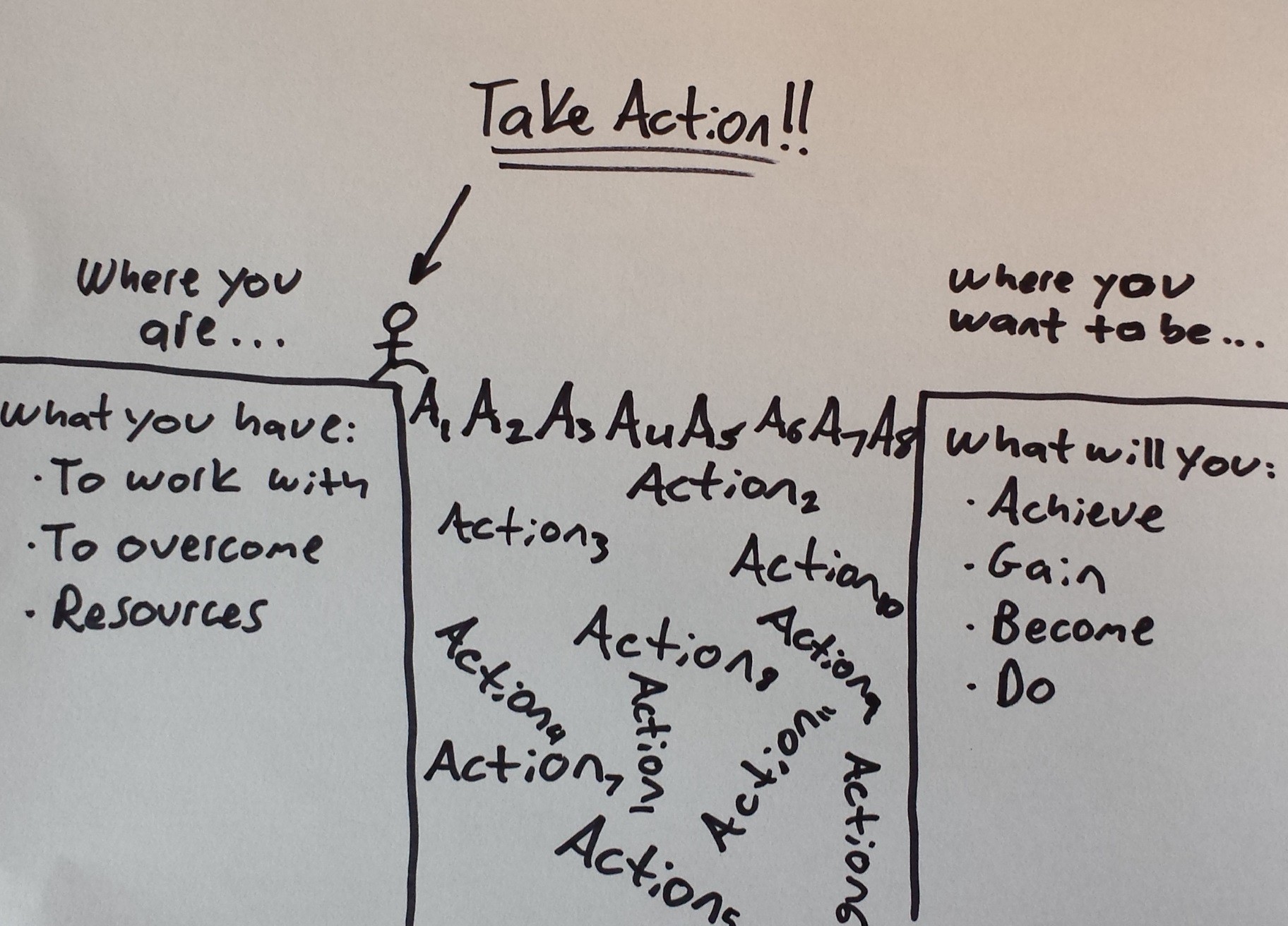
Now, we come to the most important step in the process:  TAKE ACTION!  The best plan is useless until we take action toward implementing it.

Step5

If you’ve got a goal you’d like to achieve, but need a plan on how to achieve, try this simple exercise.  It will give you clarity on what needs to be done, and motivation to see what you’re moving toward.

Just remember that the most important thing you can do, once you’ve completed the plan, is take action.  Your goals are waiting.  Start today.

Why it’s not Always Good to Have All the Answers

It’s nice to have the answer to a question or problem.  But what happens when we think we have all the answers to every question, and that our answers are better than everyone else’s?

Here are 5 dangers of thinking we have all the answers:

  1. We won’t gain new skills and experience. When we think we have all the answers, we aren’t open to trying new approaches to solving problems.  This keeps us from gaining new skills that come from new experiences.
  2. Our problem solving skills will not improve. If we already know the answer to every question, we won’t have opportunity to exercise our problem solving skills.  Instead, we’ll continue to simply rely on our own limited knowledge and miss the challenge of considering new methods to solve a problem.
  3. We won’t be able to collaborate with or leverage the knowledge of others. If think we know everything, we won’t seek assistance from others, or avail ourselves to the knowledge and experience they have.  This limits our exposure to new thoughts and ideas that we may have never heard or considered.
  4. We are not likely to attract or keep good thinkers on our teams. Good thinkers don’t want to be around people that have all the answers, because good thinkers like to think and share ideas. If we have all the answers, the good thinkers around us will go elsewhere; and take their good thinking with them.
  5. We’ll never create anything bigger than ourselves. If we rely only on what we know and our limited answers, we waste opportunities to collaborate with others in order to create something that is much bigger than ourselves.  How can we possibly create something bigger than ourselves if we only rely on our own limited knowledge?

Don’t get me wrong, its’ good to have answers to questions and problems, and when we have answers, we should share them with others.  However, I think it’s foolish to assume that we are possible of having ALL the answers to EVERY problem or question.

If, in the very rare case, we do indeed have all the answers to every question or problem we encounter, that is probably a good indication we need to step out of our comfort zone and do something else.

Does it Really Matter

Does it really matter if today you:

  • Exercise or go to the gym
  • Eat a healthy diet
  • Zone out in front of the TV all night instead of doing something more productive
  • Hold a grudge
  • Spend time improving yourself through reading and study
  • Neglect the most important relationships in your life
  • Complain about things that aren’t going well in your life

My response is, no.  In the big scheme of things, it doesn’t really matter if you did one or all of those things today.  In fact, I would even argue that it likely wouldn’t matter much if you did or didn’t do all of those things for a whole week.

But eventually, it will matter.

Suppose you want lose a few pounds and be healthier, so today to start eating better and exercising.  At the end of today, after you’ve eaten well and exercised, are you going to notice a significant difference?  Will you be healthier and at your desired weight?  No, you won’t.   You’ll look the same as you did the day before.  It’s likely you won’t even notice much of a difference after a week.  This is a point where people become frustrated, and often give up on a long term goal; when significant results don’t immediately follow effort.

However, if you stick with your plan to eat well and exercise every day, after 365 days, you’re going to notice a big difference.  At the end of the year you will undoubtedly look and feel much different, and better, than you did 365 days ago.

Now suppose at the end of 365 days of sticking with your plan I was to ask you, “So which day out of the last 365 days caused you to achieve the results you’re enjoying today?”  You might say it was the day you decided to take action, to which I would absolutely agree.  But if I pressed, to know which specific day’s effort made all the difference, your answer would be:  they all did.

Likewise, suppose you’re in good shape and living a healthy lifestyle, but you decide to skip working out today and also to eat foods that aren’t the healthiest.  Will this day totally ruin your health?  No.  If you return to your healthy lifestyle tomorrow, will this one day’s activity even make a dent in the big picture of your health?  No, it won’t.  But, if you continue this habit for 365 days, you’ll also see significant results in the deterioration of your health.

It’s the compounding effect of our consistent actions that yield results in our life, both positive and negative.  This compounding is at play shaping all areas of our lives:  health, relationships, career, personal development, finances, and attitude.

Is there any area in your life where you’d like the compounding effect to work for your benefit to achieve results you’re looking for?  If so, begin by following this simple checklist:

  1. Think about the change you’d like to make, and what your life looks like as a result of this change.
  2. Determine the actions you need to take today to achieve your desired result.
  3. Take those actions.
  4. Go through all 4 steps in this checklist again tomorrow.

We’re all building something with our lives, and the compounding effect is a significant principle that will yield powerful results, both positive and negative.

So decide today to put the compounding effect to work for you by providing consistent actions that will yield the results you’re after.  And if you mess up or miss a day, don’t be too hard on yourself, and certainly don’t give up as a result.  Just recommit the next day, and get back to providing the consistent effort that will be rewarded by the compounding effect; because it really does matter.

Put Yourself on Airplane Mode

One of my favorite features on my smart phone is Airplane Mode.  Yes, seriously, Airplane Mode.  You know that function which keeps your phone from connecting to networks, the internet or cell phone communication.  I love that feature!

I know that may sound rather stupid.  Why would my favorite feature on an amazing communication and information gathering device be to disable its ability to do all those amazing things?  While I’m a huge fan of smart phone technology and the benefits they provide, I also appreciate the ability to hold that technology at bay when it starts to become a hindrance to what I should be currently focusing on.

For example, I don’t need internet access, text messaging, email, or social media updates when I’m:

  • Focusing on a task or project that requires my full concentration.
  • Enjoying a non-technical event or outing.
  • Spending face-to-face time with other people.

In these instances, rarely, if ever, does the intrusion of a smart phone add to the occasion.

In addition to putting our phones on Airplane Mode, I think we can do likewise with ourselves and our environment.  We can remove distractions and external intrusions that hinder our ability to be fully engaged in the events and the people in our lives by taking simple steps like:

  • Engage in activities that are active and require participation and interaction from everyone involved.
  • Spending time with people in a non-technical environment, like the outdoors or a space without computers, televisions and other devices that vie for your attention.
  • Declare the next outing or event with friends or family an “Airplane Mode event” where all participants place their phones on Airplane Mode, during the event.

Sure, these ideas may seem awkward at first, but taking steps to better connect with those close to you is always worth pursuing.  Who knows, you might be amazed at how much actually learn about others.

The Secret Ingredient

I believe there is a not-so-secret ingredient to achieving results in any area of your life.  Before I share this not-so-secret ingredient, let’s first review the other necessary ingredients in the proven formula for achieving results:

Vision + Knowledge + ? = Results

The first 2 components of the formula make sense, right?  Without a vision of the result you want, it would be challenging to even know where to begin.  We must first know where we’re going (know the result we seek) before we can move toward its achievement.

Likewise, we must also possess the knowledge required to achieve the results we want.  A vision will only prove frustrating if we lack the requisite knowledge for its attainment.

So, you’re probably wondering, “What is the secret ingredient you say I need in order to achieve results?”  The complete formula for achieving results is:

Vision + Knowledge + ACTION = Results

Does that secret ingredient leave you feeling dissatisfied?  Were you perhaps expecting something more exciting and grand?  The truth is, any results or success we seek only come through the disciplined and consistent application of action.  We’re not talking about action that fills our time and causes us to appear busy, but rather specific actions that move us closer to our desired results.

Very often, this is the step that trips people up.  If we’re honest with ourselves, we usually know the necessary action we should be taking to achieve the results we want.  We simply need to be courageous enough to take the action we already know we should.  We need to cause something to happen.

What results are you trying to achieve that could use a healthy dose of necessary action?  You probably already know what action you need to take.  So… when will you take it?  Today would be a good day to start.

Don’t delay.  Results await!

Let Others Go First

So what do you do when you’re in a meeting or a conversation with someone, and each of you has something important to say or share?  Do you start talking over each other until one participant gives up and lets the other continue?  Do you minimize the other person’s position or topic and stress the importance yours until they finally “realizes” that they need to be quiet and consider themselves “blessed” to be hearing your thoughts and opinions?  No, those are bad suggestions.

Instead, I would suggest that you let the other person go first.

It’s tough, waiting to share a great idea or information with others.  Especially when it’s something you’ve put a lot of time and thought into.  You’re excited by the work you’ve done and want to share it with others.  However, it’s important to realize the other person is just as eager to share their idea with you.

Here’s why I suggest letting the other person go first:  If you go first, they won’t really be listening to you, because they will be preoccupied waiting for an opportunity to share their thought.  For me, I’d rather let someone go first and have their full attention as I go second.

Here some suggestions to keep in mind when letting someone go first:

  • Jot down what you want to share so you don’t forget.
  • Invite the other person to go first by saying something like, “I’ve got a thought on this, but I’d like to hear your take first. What do you think?”
  • Actually listen to what they say.  If you fake it, and just pretend to listen, they’ll know, and you can expect likewise when it’s your turn.
  • Ask for feedback or clarification you might need on what they said.
  • When it’s you turn, point out any similarities or places where your thoughts intersect with the other person’s.

Letting the other person go first doesn’t guarantee that you’ll have their undivided attention, but at least you’ll increase the likelihood of having it.  And if they are totally checked out or disinterested in what you’re saying, that’s a strong signal as to their potential involvement or support for your idea, which is good to know, because you can then look for others to share your idea with who would be more supportive.

Ultimately, others go first is about paving the way for better communication with others, and increasing the probability of being heard by others, as well as hearing them.

So give it a try in the weeks ahead.  When you have the opportunity, let someone else go first and see what happens.  My hunch is that not only will more of your ideas get heard, the other person will appreciate the respect you showed them by letting them go first, and listening to what they said.

Swing for the Fence

Imagine you’re on a baseball team and it’s your turn to bat.  You’ve been practicing at the batting cage, and you’ve become quite good; not to mention, you enjoy batting.  Could you imagine saying to your coach, “You know what, Coach?  I don’t know if I’m ready for this.  What if I strike out?  I think I’ll skip my turn and go back to the comfort and security of the batting cage and let someone else bat instead.”

That would be ridiculous, right?  Who would do that?!

I would argue that we may be guilty of doing something similar when we doubt or play down our abilities in the face of opportunities that would grow and stretch us out of our comfort zone.

It’s easy to wish for opportunity, or even seek it out, in the comfort of the daily routine.  However, when an opportunity actually presents itself, we often begin doubting our abilities and whether we’re really capable of being successful.  We wonder if we are capable of rising to the challenge, or if maybe we’re really not as good as we, or others, might think.

It’s totally normal to have some doubts or be nervous about taking on a new and challenging opportunity.  However, what’s tragic is when we decide not to pursue an opportunity we’re capable of either out of fear of failing or because we doubt our own proven skills and ability.

I heard a quote recently that stated:

“In 20 years we won’t be disappointed by the things we did to; we’ll be most disappointed by the things we didn’t do.”

The next time you’re presented with an opportunity that will stretch you and your abilities, grab your bat, step up to the plate, and swing for the fence!  Take the risk.  Step out of your comfort zone and into the challenge, and give it your best shot.  And if you happen to fail, which you most likely will NOT, at least you’ll go down swinging.

Always remember: No Grand Slam home runs have ever been hit from the safety and security of the batting cage.

Investing in Memories

In 2012, my wife and I decided to be more mindful about investing our time in things that matter.  For example, we decided to start traveling to places and doing things we had only talked about until then.  We also decided to be more intentional about investing our time to create lasting memories with friends and family.

We started doing this with my wife’s sister, by meeting her husband and their 2 young boys in Disneyland in 2012 and 2013 and visiting them at their home in Arizona in 2014.  Each event was filled with a lot of laughs, goofing around, and time spent together.

Last week, they were in Oregon with us during Spring Break and we again spent time goofing around and enjoying each other’s company.  One thing that surprised me about this particular visit was how often our nephews said, “Do you remember when…?”  Their memories ranged from something we did a few years ago to something we had done just an hour prior.  Some of the events they remembered seemed so small and insignificant, I was wondering why they would even remember that; but regardless, they remembered, and wanted to know that we remembered too.

I mentioned this to my wife, as we talked about our decisions back in 2012 to be intentional about investing our time in making memories with loved ones.  It appears that our efforts are paying off.

It’s not terribly difficult to be intentional about investing our time in making memories.  Sure, there may be some monetary investment to get to the same place geographically, but once you’re together, making memories, especially with young people, is not that difficult.  We’ve found the following simple things work well for creating memories:

  • Spend time doing things where you’re interacting together.
  • Give others your attention by putting away technology and focusing on what you’re doing and who you’re with.
  • Goof off, be silly, laugh, and enjoy the time together.

What friends or family members of yours would you like to begin making lasting memories with?  Identify who they are, and make plans to begin creating opportunities to do so today.  The returns of lasting memories that will be shared for a lifetime are priceless.