You Already Know

My wife has been traveling for work a lot lately, so she’s interesting in looking for tips to help her pack lighter or more efficient.  After she had looked up some tips on-line I asked her, “So what did you learn that you can start applying?”  Her response was, “Nothing I didn’t already know.”

That response got me thinking.  How many things do we already know we should be doing, that we aren’t?  My guess is that in the gap between where we are and where we want to be, we already know the steps we need to take to get there.  At a minimum, we usually know the specific step we should take right now.

The real question then becomes; what’s keeping us from doing what we already know we should be doing?  There are several potential reasons, such as:

  • Fear – of all sorts
  • Indecision
  • Lack of confidence
  • Lack of focus
  • Laziness
  • Maybe we just don’t feel like putting forth the effort

So there we sit, where we’ve always been because we know what we need to do, but don’t do it.

Think about that.  When we already know what we need to be doing to achieve a desired outcome, and fail to act, the only thing standing between us and our goal… is us!

What do you already know you should be doing, that you currently aren’t?  Do you already know what you need to be doing in order to:

  • Improve a relationship
  • Get in better health/shape
  • Manage your finances better
  • Advance your career
  • Improve yourself intellectually or spiritually
  • Live the life you desire

If you answered, “Yes”, then starting today, get out of your own way and do what you already know you need to be doing.  You are not only the biggest obstacle to overcome in achieving your dreams; you are also the greatest force to bring them about.

Connect Around a Common Interest

As iron sharpens iron, so one man sharpens another.

~Proverbs 27:17 (NIV)

I had 2 opportunities this week to talk with people who were as excited as I was about a common topic.  The first opportunity centered on a software tool called QlikView.  The other was around the area of personal development.

In both cases, there was an excitement as we discussed our common interest.  Ideas were shared, questions were asked and answered, problems and setbacks were discussed, and suggestions for improvement were provided.   I loved the exchanged because I felt like I was not only heard, but I got to give value to the other people, as well as receiving value from them in return.  Those exchanges were highlights of my week.

It reminds me how important it is to spend time with people who are on the same path as me, in an area where I want to improve.  Some of the benefits of doing so include:

  • Being exposed to new thoughts, concepts, and ideas
  • Deepening your understanding of the topic
  • Sharing what you’ve learned with others
  • Being able to ask questions to someone who can potentially help you or point you in the right direction
  • Making connections with people who share a common interest
  • Increasing your network
  • Hearing what other people are working on, struggling with, or discovering in the same area as you
  • Feeling like you’re on a journey with others instead of being isolated and traveling alone

Those conversations this week were very rewarding, and left me wanting more interactions just like those.  I’ll certainly be looking for similar opportunities, only at a higher frequency per week.

Be on the lookout starting today for opportunities to connect with others around a common interest.  Not only will you have fun discussing it with someone else, you just may have the knowledge and experience someone else needs to hear in order to get unstuck.

How to Make a Difference

Most people have a desire to make a difference.  Whether it’s in their family, relationships, community, or career, people want to know what they’re doing, or have done, matters; that they have added value to others; that their efforts have made a difference.

I feel the same way.

Sometimes it can be challenging to determine how we can make a difference or add value to those around us.  The challenge of “how” to do this can often keep us from taking any action at all.  I think one way to determine how we can make a difference is to follow this simple 3-part process:

  1. Determine what you do well, what you enjoy doing, and what you are excited about.
  2. Find someone who has a need you are able to solve and, excited about doing so.
  3. Get started.

I started doing this at work earlier this year, after feeling like I wasn’t making much of a difference.  Here’s what the 3-part process looked like for me:

  1. I enjoy providing information about our business in a clear, simple format that business partners can easily understand and use to make business decisions. I discovered that the company I work for has a great tool (QlikView) for building information dashboards, so I began learning how to use this tool.
  2. The business unit I support has been lacking clear, easy to understand business reporting.
  3. I began using QlikVeiw to put some dashboards together and share them as prototypes with the business. The business found the very useful and asked me to create additional dashboards to help measure the business.

Since I took this initiative to make a difference, I really feel like I’m making a significant contribution regarding how the business receives and uses data.   The work I do feels meaningful, relevant, and important.  Plus, I just love doing it!

What about you?  What do you do well or what are you interested in that you can share with others?  Look around.  Who has a problem that you can solve with the skills and interest you possess?  Have you identified them?  Good.

Now start making a difference.

This is What Discipline Looks Like

I used to play the drums when I was in high school.  Although it was fun to sit at my drum set and play, I was never very good.  What held me back was my unwillingness to put in the disciplined practice to master the fundamentals and hone my skills.  Eventually, I gave up the  drums to pursue other interests.  Looking back, I wish I would have stuck with it and been disciplined in my practice.

Since I’m familiar with drumming, I’m always interested in watching really good drummers perform.  Earlier this week, I came across a video of a performance by Neal Peart, the drummer for the band Rush.

This guy is awesome!  When I first saw the video, I was amazed at how easy Neal made playing the drums look.    As I continued watching, it became apparent that he has also spent thousands of hours mastering his craft.  He was obviously both willing and disciplined to pay the price to achieve mastery. His performance was a striking example of what the results of discipline look like.

Is there a craft or skill that you want to master or hone?  If so, realize that it will take time and effort.  However, most important, if it’s something you really want, commit yourself to its disciplined pursuit.  Be willing to put in the time required.  Neal Peat didn’t become an excellent drummer in a single day.  Neither will you achieve mastery of your craft in a single day either.  Like most things that are worthwhile, it will take time.

Be willing to put in the time.

What Do People Think

What Do People Think When They Hear You Coming

~Joni  Eareckson Tada

What do you think when you ponder that question?  Are you a value-add in that people are glad to see you and your presence is welcome, or is your presence seen as something that is an unwelcomed interruption?

If your answer to that question left you feeling slightly uncomfortable, and you’d like to improve the likelihood that you arrival will be seen as a welcomed event, try practicing the following suggestions during your interactions with others:

  • Take an interest in others and what they’re interested in, instead of focusing on your own interests.
  • Be kind to people and show them grace, because we may not know what they’re going through.
  • Look for the best in others instead of the worst, because we tend to find what we’re looking for.
  • Offer sincere praise or appreciation; most people probably don’t get enough of either.
  • Give them you undistracted attention; by doing so you’ll communicate that they’re important to you.

We all want to be viewed as a value-add, and someone whose presence is appreciated and valued.  The best way to cause this is to value others and communicate that by showing them kindness, appreciation, attention, and respect.

Look for opportunities to put these suggestions into practice starting today.  When you do, people we will look forward to your arrival.

Your Comfort Zone and Beyond               

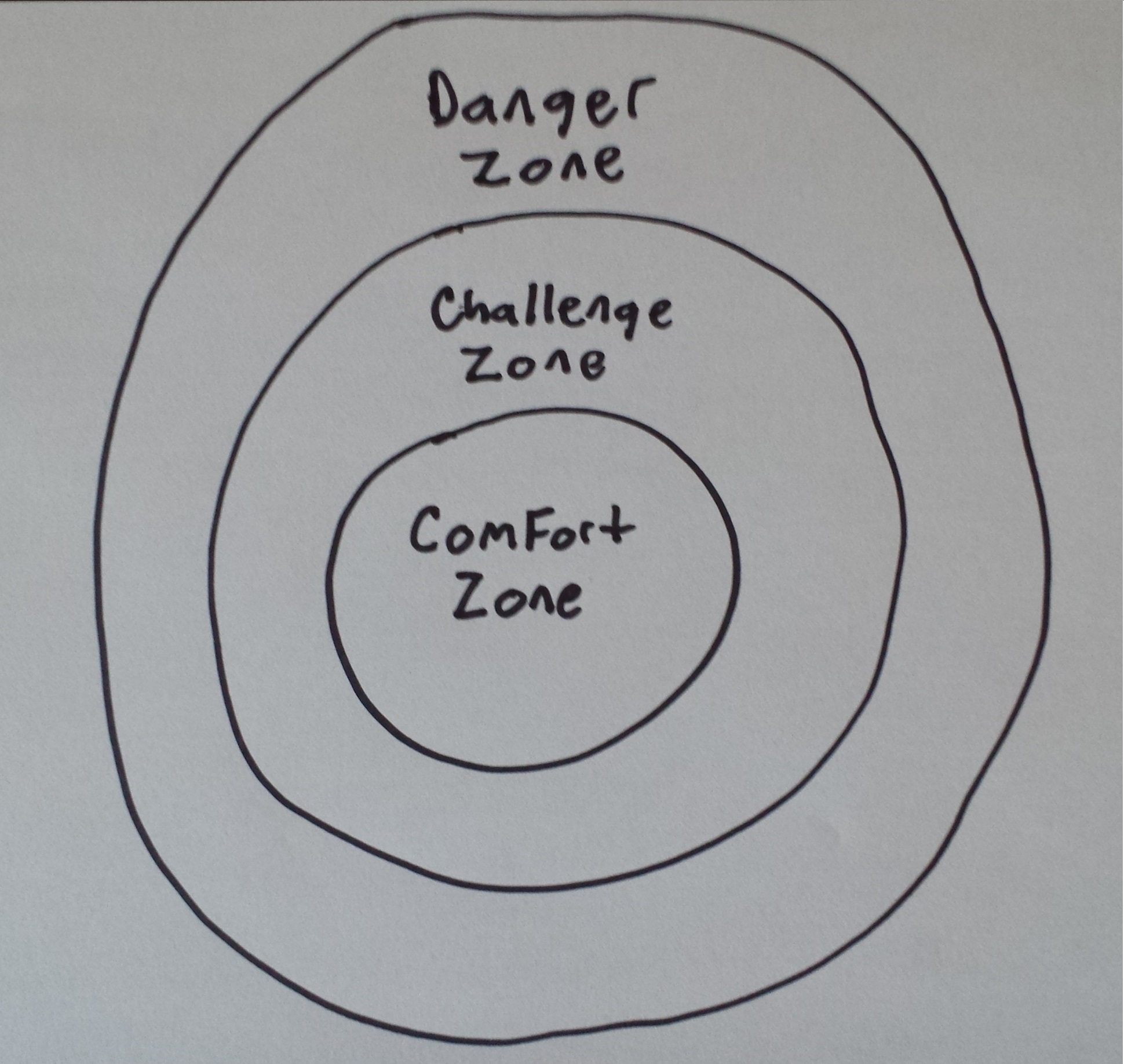
We all know that in order to stretch and grow we must consistently get out of our Comfort Zone.  But just how far out of our Comfort Zone should we be going?  Is there a limit?

I think there are 3 sections relating to our Comfort Zone that look like the following:

ComfortZoneGraphic-4-Jul-15

The characteristics of each section are as follows:

Our Comfort Zone:

  • Things you attempt are easy to accomplish
  • Success is almost certain
  • This space can expand as we master items in our Challenge Zone

Our Challenge Zone:

  • Things in this zone represent endeavors we have not yet attempted, or are in the early stages of trying
  • Success is not certain, but is likely with practice and continued effort
  • Mastery of items in this zone causes those items to move out of our Challenge Zone and into our expanded Comfort Zone

Our Danger Zone:

  • Items in this space represent skills or talents we do not yet , or may never, possess
  • Outcomes are disastrous at best; dangerous at worst
  • Items in this space can move into our Challenge Zone, and even our Comfort Zone, but only after significant effort, failure, and disciplined practice; it is a slow process

When we step out of our Comfort Zone, we should look for those items that lie within our Challenge Zone, perhaps those items close to, but not exceeding, the far edge of our Challenge Zone.  These items are the ones that will stretch us the most and cause the most rapid growth.

Take for example, a person who wants to be an airline pilot who has never flown an airplane before.  They would not start out flying a 500+ passenger aircraft for a major airline.  That would certainly be in their Danger Zone and would have disastrous consequences.  They’d first start out learning to fly small single engine airplanes.  Initially, this would be something that would be in their Challenge Zone, but as they spend time with a flight instructor, they would eventually develop mastery in this area.  At that point, flying small single engine aircraft would be in their Comfort Zone and they would be ready to move to move up to the next larger aircraft that is in their Challenge Zone.  They would continue learning to become familiar with increasingly complex aircraft, until that 500+ passenger aircraft has moved from their Danger Zone into their Challenge Zone.  At that point, they would begin training in that aircraft, until its mastery, which was once in their Danger Zone, becomes part of their Comfort Zone.

Moving items from the Danger Zone to the Comfort Zone is a process that is usually timely and slow, so patience and discipline is required.

What items would you like to add to your Comfort Zone?  What item in your Challenge Zone can you begin working on today to move you one step closer to its mastery and an eventual placement in your Comfort Zone?  Don’t wait!  Get started today and begin seeing your Comfort Zone expand as you achieve things you never thought possible.

Pause and Ask Yourself

We’ve all had situations where we are struggling in our relationship with a person we closely interact with, be it through work, family, or some other community.  When we do, it’s easy to point at them and identify their faults, or how their actions are making the situation worse.  I think that a more productive thing to do might be to point our finger back at ourselves and instead identify what we’re doing to negatively contribute to the situation.

Ouch!!  That Smarts!

Personally, this is not my normal course of action.  It’s a challenge to put aside what I might be feeling toward the other person and take an honest look at the role I’m playing in the scenario.  It’s much easier to keep my focus off of me and on the other person and their actions, where I self-righteously feel it should be.

I’m working to get belter in these situations.  In doing so, I’ve found that a few questions I pose to myself usually bring a new perspective to the situation.  They are:

  • What role am I playing in this scenario and how it is negatively impacting the outcome?
  • If I were an impartial 3rd party, what would I say about my actions and behavior?
  • What thoughts or beliefs am I holding that may be having a negative impact?
  • Where is the other person right, or acting with proper motives?

These questions and others like them provide a moment to pause, step back and potentially see the scenario from a whole new perspective, giving us clarity and insight we might never have gained, had we not stopped to ask them.

The next time you find yourself getting fired up at another person, pause and ask yourself one or more of these questions.   You will likely find a new perspective and potentially, a path to a positive outcome.

It’s Worth It

This week my wife and I learned that our cat Lily has cancer on her kidney and on her intestine.  The veterinarian told us she as about 1 month to live.  Bummer!

Lily

Lily

My wife is having an especially hard time knowing that Lily’s end is near.  It’s sad to think of her not being around soon.  I’m amazed at the impact a cat or dog can have in the life of its owners.  They very quickly become so significant, so important, and so loved, which makes it so painful when they leave us.

The sadness and pain we feel over the loss of a pet is evidence that we loved them, and that they brought something positive to our lives while they were with us.  When compared to the joy we receive while they’re with us, the pain of losing them is relatively miniscule, but it still hurts.

It would be easy to avoid that pain, by ether never having a pet, or by not loving or becoming attached to them.  I don’t think either of those are very good options, at least for me.  Had we thought this way about Lily, my wife and I would have missed out on so much joy that we experienced with her.  I’m glad we didn’t miss it.

What I’ve been reminded of this week is that loving a pet, and even a person, comes with a price.  Although that price is sometimes painful, as in the case of loss and separation, it’s worth it.

For my wife and me, our plan is to love Lily up during her final weeks and send her out well loved and well-remembered.    I know that saying good-bye to her will be painful… but it will have been so worth it.

Don’t Pursue Happiness

We should never pursue happiness.  That sounds weird to read, and write, but I believe it’s true.  I don’t think we should pursue being happy as our primary goal.

I’ve heard people say that they just “want to be happy”, but when questioned, they often lack a plan or any idea how to achieve the happiness they seek.

I think our efforts would be better spent focusing on doing the things that bring happiness.  “But wait!” you might be saying.  “Isn’t that the same thing as pursuing happiness?”  Not really.  Here’s why.

Being happy is a byproduct of doing something else.  The feeling of being happy follows an action.  You don’t just “be happy”.  Something comes first; some initial action sparks happiness.  The action is the cause, happiness is the effect.

Here’s what this looks like in the real world.  If you want to be happy, determine the things that make you happy, and do those things.  (The premise I’m working from is that the things that make you happy are good, moral, legal, and will build you up and those around you.)  Perhaps being in good physical condition or serving others makes you happy.  Maybe something in your career or spending time with family friends or a community you belong to.  It might even be using a gift or talent you possess.  Most likely there are multiple things you can do that make you happy.  Whatever those things are, do them.  Don’t avoid them or diminish their importance.

Instead of continuing pursue happiness alone, begin stoking the fire of happiness by taking the actions that cause happiness to follow.  When you do, you’ll find that happiness is waiting on the other side.